Do Fish Finders Work, and What Can They Show You?
Yes, fish finders work by sending sonar pulses into the water and showing returning echoes. Those echoes can help you read depth, bottom shape, fish-like targets, and structure, but they don't identify every fish with certainty.
On this page (5 sections)
Yes, fish finders work by sending sonar pulses into the water and displaying the echoes that return. Those echoes can help you see depth, bottom shape, fish-like targets, and underwater structure, but the screen is an interpretation, not an underwater photograph.
The useful question is what a particular display can tell you. Sonar can point you toward a promising area, while your location, movement, settings, and understanding of the screen help you judge what the marks mean.
How do fish finders work?
A fish finder sends sound pulses through a transducer and measures the echoes that return. The unit uses those echoes to estimate depth and draw a scrolling picture of the water below or around the transducer.
A strong return can come from the bottom or another object. Fish, plants, and hard structure can all create returns, so the display shows clues rather than labels that identify each object.
The transducer's position and the sonar mode shape what you see. A transom-mounted unit scans from the boat, while a castable unit can scan as you retrieve it; types of fish finders explains how those setups differ.
Do CHIRP fish finders work differently?
CHIRP sonar sends a sweep across a range of frequencies instead of one frequency at a time. That can give a unit more information to process and can help separate targets on the display.
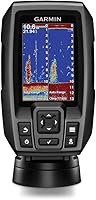
The Garmin Striker 4 combines CHIRP sonar with a traditional sonar view and ClearVü scanning sonar. Its keyed controls and built-in flasher give you options for boat use and vertical fishing.
CHIRP doesn't make every mark certain. Settings, transducer placement, depth, and the distance between targets still affect how clearly the screen separates returns.
What can a fish finder show you?
A fish finder can show water depth, the bottom, and echoes from fish or other objects. Depending on the unit and sonar mode, it may also help you make out vegetation, submerged cover, and changes in bottom shape.
A strong, even bottom return can suggest a firm surface, while changes in the return can point to a change in the bottom. Treat those clues as a reading to check against the location, not a guarantee about what's there.
Some units also use GPS to mark locations or create maps. The Humminbird Helix 5 CHIRP DI GPS G3 pairs CHIRP Down Imaging with GPS and includes AutoChart Live for recording depth contours, bottom hardness, and vegetation as you travel.
To interpret the shapes and marks, see how to read a fish finder screen. If you mainly need depth and bottom readings, fish finder or depth finder explains the difference.
Can a fish finder tell you exactly where the fish are?
It can show a fish-like return in the sonar cone, but that mark is not a precise location pin. The display is tied to the transducer's position, and the boat or transducer keeps moving as the screen scrolls.
A mark may have passed beneath the transducer by the time you react. Use depth, direction, and nearby structure to guide your next pass, then look for repeated returns in the same area.
Why can fish finder readings be hard to interpret?
A fish finder can show confusing marks when settings, movement, or conditions change the echoes. A cluttered display doesn't always mean the unit is broken or that every mark represents a fish.
Sensitivity that's too high can make unwanted returns more visible. Range settings that don't match the depth can also make the useful part of the picture harder to read.
The transducer matters too. If it's poorly placed for the boat or loses a clean signal as the boat moves, the display may become less useful; our guide to where to mount a fish finder transducer covers placement.
Do fish finders work in shallow water?
Yes, but shallow water can leave less room on the screen to separate the bottom from nearby targets. A strong bottom return may take up much of the view, and settings that suit deeper water may not read as clearly.
Set the depth range for the water you're fishing and check whether the transducer stays in the water as you move. Change one setting at a time so you can tell what improves the display.
Can fish finders work from shore, a kayak, or through ice?
Yes, if the sonar unit is made for that setup. A boat-mounted unit uses its transducer from a boat, while castable, paddle-craft, and ice-fishing setups have different ways to put the sonar in the water.
The Garmin Striker Cast with GPS pairs with a phone or tablet and streams sonar wirelessly from up to 200 ft away. Its traditional 2D and ice flasher modes make it an option for casting from shore, a dock, or a watercraft.
For a kayak, start with portable fish finders for kayaks and how to mount a fish finder on a kayak. For vertical fishing, fish finders for ice fishing covers units and setups intended for use through the ice.
What should you expect from a fish finder?
Expect useful clues about depth, bottom, and possible fish, rather than a guarantee of a catch. A sonar display can help you choose where to fish and return to a marked location, but it can't make the decision or the catch for you.
Start with the feature that fits your fishing: a mounted transducer for a boat, a portable unit for changing setups, or castable sonar for shore access. If you're new to the screens, fish finders for first-time owners can help you compare simpler choices.
Choose a boat unit if you want readings from a mounted transducer; choose castable sonar if you need to scan water from shore or while moving between spots. Fish finders work best as tools for reading clues, and knowing what those clues can and can't tell you makes them more useful.
Frequently asked questions
Do fish finders actually show fish?
Yes, a fish finder can show echoes that may come from fish, often as arches or other marks depending on the sonar view and conditions. It cannot confirm a species or guarantee that every mark is a fish.
Check the depth, bottom, nearby cover, and how the mark changes as you move.
Can a fish finder see through water?
A fish finder's sonar travels through water and returns when it meets objects or boundaries such as the bottom, vegetation, or fish. It does not give you a camera view through the water.
The display translates echoes into marks, so learn the screen settings and read those marks in context.
Do fish finders work in shallow water?
Yes, fish finders can work in shallow water, though the usable view depends on the unit, transducer setup, depth, and conditions. A shallow bottom can fill much of the screen, and surface clutter may obscure nearby targets.
Adjust the range and sensitivity, then compare the display with what you know about the location.
Do fish finders work from shore?
Some do. Castable sonar units can send readings to a phone or tablet as you retrieve them, while boat units are designed around a transducer mounted in or on a watercraft.
Check the unit's intended setup and wireless range before choosing one for shore fishing.