9 Best Fish Finders on a Budget (November 2026)
The best affordable fish finders include the FishPRO 2026 Upgrade Underwater Camera for watching fish react to bait, the ReelSonar iBobber for casting from shore or dock, and the Humminbird Helix 5 CHIRP GPS G3 for boat navigation and mapping.
On this page (9 sections)
- The best budget fish finders for each kind of fishing
- How these budget fish finders compare
- How we chose these budget fish finders
- What should you spend on a budget fish finder?
- Which fish finder works for kayaks and small boats?
- Do budget fish finders need a phone or a screen?
- How much depth range do you need?
- What else matters in a cheap fish finder?
- Which budget fish finder is right for you?
The best fish finder on a budget for most anglers is the FishPRO 2026 Upgrade underwater camera, because it shows a clear color picture of your bait and the fish around it for up to 20 hours on one charge. If you fish from shore or a dock, the ReelSonar iBobber casts out and reads to 135 ft.
For a boat with GPS and mapping, the Humminbird Helix 5 is the strongest cheap mount.
A tight budget does not mean guessing where the fish are. The units here cover ice holes, kayaks, docks and small boats, and each one gets you real depth and fish readings without a premium price tag.
Start with our guide to what a fish finder is used for if you are still deciding between sonar and a camera. New to electronics on the water?
The best fish finders for beginners covers the basics of setup.
Our picks at a glance
-
1
 Best for watching fish react to bait
FishPRO 2026 Upgrade Underwater Camera
9.6/10 our score
See it on Amazon -
2
-
3
 Best for boat navigation and mapping
Humminbird Helix 5 CHIRP GPS G3
8.8/10 our score
See it on Amazon
The best budget fish finders for each kind of fishing
The FishPRO camera wins overall for the clearest view of fish behavior. The rest of the list covers castable sonar, mounted boat units, ice flashers and long-range wireless options so you can match the unit to the water you actually fish.
FishPRO 2026 Upgrade Underwater Camera: Best for watching fish react to bait
- 7-inch IPS screen
- 82 ft cable
- 10,000mAh battery
- IR and LED lighting
A true HD 1080P camera feed in color, with a big screen and a battery that runs all day. It is the most useful budget pick for anyone who fishes from ice or a boat.
Pros
- Clear HD 1080P view
- Up to 20 hours on a charge
- Switchable IR and white LED light
Cons
- No video recording or HDMI out
- Not a sonar unit for wide searching
FishPRO suits ice anglers and boaters who want to see, not just guess. The 2026 model delivers a true HD 1080P picture on a 7-inch full-color IPS screen, so you can watch how a fish approaches your bait and reacts to it.
A 45, 90 or 180 degree fin lets you aim the camera around the hole.
Battery life is the headline: a 10,000mAh cell runs up to 20 hours, and USB-C lets you fish while charging from a power bank. The magnetic spool separates the monitor from the 82 ft cable when you need to move around.
One button switches between IR and white LED light for dark water. The 1.8 mm cable is rated to 88 lb, which matters when you lift it through ice.
FishPRO backs it with a 12-month warranty.
This model does not record video or offer HDMI output. For a camera feed at this price, the screen size and light options make it the top pick.
ReelSonar iBobber: Best for casting from shore or dock
- 135 ft depth range
- 10+ hours battery
- Fish and strike alarms
- Bluetooth app
A castable bobber-size sonar that sends depth, fish and structure to your phone. It fits in a tackle box and works from a bank, dock or kayak.
Pros
- Tiny and easy to carry
- 135 ft depth range
- Fish and strike alarms
Cons
- Needs your phone nearby
- Not mounted for hands-free boat use
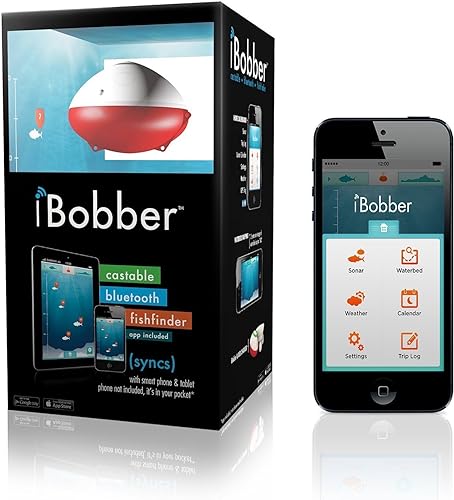
The iBobber suits the angler who fishes from a bank, pier or kayak and wants readings without a mount. It is small enough to keep in a tackle box, and you cast it out like a bobber to read depth, bottom contour and fish.
Its sonar reaches 135 ft and runs 10+ hours on a charge. The app syncs over Bluetooth to your phone and color-codes fish icons by size.
A fish alarm sounds when fish gather under a dock or pier, and a strike alert flags bites.
Because it floats and syncs wirelessly, it also works for ice fishing and night fishing with its LED beacon. The app lets you map waterbeds, mark spots and log water temperature.
The trade-off is phone dependence: the display lives on your screen, not a dedicated unit. For casting from shore at a low price, it is hard to beat.
Humminbird Helix 5 CHIRP GPS G3: Best for boat navigation and mapping
- Dual Spectrum CHIRP sonar
- Built-in GPS
- AutoChart Live mapping
- 10,000+ lake basemap
A transom-mount fish finder with GPS and live mapping. It is the pick for boaters who want to mark spots and build depth maps while they fish.
Pros
- Built-in GPS and basemap
- AutoChart Live contour mapping
- CHIRP wide and narrow views
Cons
- Transom mount only
- Needs a boat and wiring to get the most from it
The Helix 5 suits boaters who want to find fish and know where they are. It pairs Dual Spectrum CHIRP sonar with built-in GPS and the Humminbird Basemap covering 10,000+ lakes and U.S. coastlines.
Wide Mode scans a broad area and Narrow Mode drills into detail. AutoChart Live builds depth-contour maps while you cruise, with eight hours of built-in recording.
That means you can mark a brush pile and return to it later.
The 5-inch color screen and keypad controls work in rough weather. A transom-mount transducer and gimbal bracket come in the box.
It needs a boat, a power source and some wiring to earn its keep. If you fish from a kayak or the bank, a castable unit is simpler.
For a small boat with mapping needs, this is the budget navigator.
Deeper PRO+ 2: Best for mapping from a kayak

- Castable Wi-Fi sonar
- Built-in GPS
- 330 ft depth
- Bathymetric mapping in app
A castable sonar with three beam widths and GPS mapping. Kayak anglers who want to find structure and map water without a wired install get a lot here.
Pros
- Wide, mid and narrow beams
- Built-in GPS for bathymetric maps
- 330 ft depth range
Cons
- App-only display
- Lighter casting control than a rod-mounted unit
Deeper PRO+ 2 suits kayak and boat anglers who want to map water without a wired install. Its three beam widths (wide, mid and narrow) let you cover water fast or lock onto a single spot.
Built-in GPS lets you create bathymetric maps from shore, dock or bank and save them in the Fish Deeper app. Sonar accuracy reaches 330 ft, and target separation is 0.4 in on the narrow beam, so even a small jig shows up when you vertical fish.
Wi-Fi connectivity is strong and steady, and the unit is light enough to cast. The app does the display work, so bring a charged phone or tablet.
Compare it with the Humminbird if you want a fixed screen on a console. Pick the PRO+ 2 when portability and mapping matter more than a mounted unit.
Yoocylii Handheld Fish Finder: Best for the simplest kayak setup

- 4.6 cm LCD screen
- 328 ft depth range
- 45-degree beam
- Neck strap included
A toss-and-read handheld sonar with a basic screen and a neck strap. It is the least fussy way to add depth and fish readings to a small kayak.
Pros
- Simple toss-the-transducer use
- Reads to 328 ft
- Neck strap and tackle-box size
Cons
- AAA batteries last about 4 to 5 hours
- Small screen shows basic data only
The Yoocylii is the easiest way onto the water for a kayak angler. Toss the transducer, turn on the display and read depth, fish location and bottom type.
A 45-degree beam covers a useful cone under the sensor.
It reads to 328 ft and shows fish size as small, medium or big, plus weeds, sand and rock. Five sensitivity levels and a backlight help in different light.
The neck strap keeps the display handy while you paddle.
It runs on 4 AAA batteries for about 4 to 5 hours. That is shorter than the rechargeable units here, so carry spares for a long day.
The small screen shows basic data rather than a detailed sonar picture. For the money and the simple setup, it is the least intimidating unit in this roundup.
Hawkeye FishPod 5x: Best for ice fishing flasher fans

- Four preset modes
- FishEcho target tuning
- Vertical flasher
- 199 ft depth range
A bobber-style Bluetooth sonar with AI-tuned presets and a vertical flasher. Ice anglers who like a flasher view get a light, easy-to-carry option.
Pros
- Vertical flasher for ice
- Four preset modes
- TraxNut mount fits standard brackets
Cons
- 199 ft depth limit
- Needs a phone app to read
The FishPod 5x suits ice anglers who like a flasher view. Its vertical flasher amplifies the newest sonar echoes so you can track a jig and a fish in real time.
Four preset modes auto-tune the screen for fish by size, depth or schooling.
FishEcho tunes out clutter and false echoes, while BottomScan separates vegetation from soft or hard bottoms. It reads to 199 ft through ice.
The TraxNut mount attaches to any 1/4 x 20 bracket, so it can sit on a rod holder or a small platform. It syncs over Bluetooth to a phone app.
Depth tops out at 199 ft and the display is on your phone. For a dedicated ice unit at a low price, the flasher and presets make it a strong pick.
Lowrance Eagle 4x: Best for small boats and kayaks

- 4-inch IPS screen
- Auto-Tuning Sonar
- 44-degree Bullet Skimmer
- 500 ft depth range
A compact mounted fish finder with a bright portrait screen and auto sonar tuning. It is the budget choice for a small boat or kayak that wants a fixed unit.
Pros
- Bright IPS screen
- Auto-Tuning Sonar reduces fiddling
- 500 ft depth range
Cons
- 4-inch screen is small for wide views
- No built-in GPS or mapping
The Lowrance Eagle 4x suits a small boat or kayak that wants a mounted screen. Its 4-inch IPS portrait display stays readable in bright sun, from wide angles and through polarized sunglasses.
Auto-Tuning Sonar sets itself, so you spend time fishing instead of adjusting. The included 200 kHz Bullet Skimmer casts a wide 44-degree beam, and the unit reads to 500 ft.
A twist-lock connector makes the display easy to remove and store.
Fish icons show depth, and zoom gives a closer look without an alarm. It fits tight spaces thanks to the compact portrait body.
There is no GPS or mapping, and the screen is small for wide views. Pick it when you want a dependable mounted unit without paying for navigation features.
Deeper Start: Best for shore and bank fishing

- Castable Wi-Fi sonar
- 165 ft depth
- 40-degree beam
- 6-hour battery
A castable sonar for anglers who fish from shore. It sends depth, fish and bottom contour to the Fish Deeper app without using your mobile data.
Pros
- Easy to cast from a bank
- Free Fish Deeper app
- Night fishing mode
Cons
- Shorter 6-hour battery
- 40-degree beam is narrower than the PRO+ 2
The Deeper Start suits bank and shore anglers who want to read water they cannot reach. Cast it out to 165 ft and it sends depth, fish location and bottom contour to the Fish Deeper app.
It runs its own Wi-Fi, so it does not eat your mobile data, and it saves each scan with time and location. A 40-degree beam gives decent coverage.
Night fishing mode helps after dark.
Battery life is about 6 hours, and a full charge takes 2.5 hours. That is shorter than the PRO+ 2 and the FishPRO, so plan around it.
It does not have the PRO+ 2's GPS mapping or three beam widths. For an affordable first sonar you cast from the bank, the Start is the simple choice.
LUCKY Kayak Wireless Fish Finder: Best for long-range wireless casting

- 853 ft wireless range
- 3.5-inch horizontal LCD
- 90-degree beam
- 147 ft depth range
A castable sensor paired with its own handheld display. The long wireless range suits kayakers who want a screen without a phone.
Pros
- 853 ft wireless range
- Standalone 3.5-inch display
- 90-degree wide beam
Cons
- 147 ft depth limit
- Narrowest depth range in this group
The LUCKY kayak finder suits paddlers who want a display without a phone. Its 853 ft wireless range is one of the longest here, so you can cast the sensor far from the boat and still read it.
The 3.5-inch horizontal LCD scrolls right to left, showing fish icons with depth numbers. A 90-degree beam scans a wide area from 3 to 147 ft.
The handheld display and floating sensor together weigh less than a 1-liter water bottle. Tie the sensor to your line or the included tether and cast it like a bobber.
It works for shore, kayak, boat and ice fishing.
The 147 ft depth limit is the shallowest in this group. That is fine for most lakes and rivers, but deep water anglers should look higher up the list.
For a phone-free castable unit, it earns its place.
How these budget fish finders compare
The table lines up screen type, depth limit, power and mounting so you can see the trade-offs at a glance. A camera and a sonar unit do different jobs, and the table makes that difference clear.
| Product | Best for | Screen | Max depth | Battery | Our score |
|---|---|---|---|---|---|
| FishPRO 2026 Upgrade Underwater Camera | watching fish react to bait | 7 in IPS | 82 ft | 10,000mAh, up to 20 hrs | 9.6 |
| ReelSonar iBobber | casting from shore or dock | 135 ft | 10+ hrs | 9.1 | |
| Humminbird Helix 5 CHIRP GPS G3 | boat navigation and mapping | 5 in color TFT | 8.8 | ||
| Deeper PRO+ 2 | mapping from a kayak | 330 ft | 8.5 | ||
| Yoocylii Handheld Fish Finder | the simplest kayak setup | 4.6 cm LCD | 328 ft | 4 AAA | 8.2 |
| Hawkeye FishPod 5x | ice fishing flasher fans | 199 ft | 8.0 | ||
| Lowrance Eagle 4x | small boats and kayaks | 4 in IPS | 500 ft | 7.6 | |
| Deeper Start | shore and bank fishing | 165 ft | 6 hrs | 7.2 | |
| LUCKY Kayak Wireless Fish Finder | long-range wireless casting | 147 ft | Rechargeable | 6.8 |
How we chose these budget fish finders
We compared specs and features against what each kind of angler needs, then scored each unit on how well it delivers that job at a low price. Depth range, screen size, power source, mounting and whether a unit needs a phone all counted.
A camera and a sonar unit are not the same tool. The FishPRO shows you a picture of fish and structure; a sonar unit like the Helix 5 measures depth and marks fish below the boat.
We ranked both because budget buyers ask for both.
Our score weighs specs, features and buyer feedback against what you are shopping for. We did not test these units on the water.
We read the published specs and matched them to common fishing situations.
What should you spend on a budget fish finder?
Set your budget by the type of unit first, then pick the features you need. A castable or handheld sonar is the cheapest way to get depth and fish readings.
A mounted unit with GPS costs more but adds navigation.
Camera units like the FishPRO sit in the middle: they cost more than a basic handheld but show a real picture. Decide whether you want to watch fish or just find them.
What a castable sonar gives you for the money
A castable unit skips wiring, a boat battery and a mount. The iBobber and Deeper Start send readings to a phone app, so the sensor does the work and your phone is the screen.
That keeps the cost down and makes the unit easy to carry. The catch is that you need a charged phone, and the display lives on the app.
What a mounted unit adds
A mounted unit like the Helix 5 or Lowrance Eagle 4x puts a fixed screen on your boat. It stays charged from the boat's power and reads while you cruise.
You get a larger, brighter screen and hands-free reading. The trade-off is installation: a transducer, wiring and a mounting bracket.
Which fish finder works for kayaks and small boats?
A compact mounted unit or a castable sonar fits a kayak best. The Lowrance Eagle 4x has a small portrait screen and a twist-lock connector, so it fits tight spaces.
The LUCKY finder pairs a handheld display with a floating sensor for a phone-free option.
A kayak has little room and no console. Pick a unit that runs on its own battery and mounts with a small bracket.
The Deeper PRO+ 2 also works well here because it casts out and maps in the app.
For rivers with current, a castable unit that floats and syncs wirelessly is easier than a fixed transducer. Our best fish finders for river fishing covers current and structure in more detail.
Do budget fish finders need a phone or a screen?
It depends on the model. Castable units like the iBobber, Deeper Start and FishPod 5x use a phone app as the display.
The FishPRO camera, Yoocylii, LUCKY and Lowrance Eagle 4x have their own screens.
A phone app gives you a bigger, sharper display and easy trip logging. A built-in screen works without a phone, which matters on cold days when a phone battery drains fast.
If you fish alone in winter, a dedicated screen is safer. If you already carry a phone and want to log trips, an app-based sonar keeps the hardware small and cheap.
How much depth range do you need?
Match the depth range to the water you fish most. A 135 to 200 ft range covers most lakes, rivers and ice holes.
Pick 330 ft or more for deep reservoirs or saltwater.
The iBobber reads to 135 ft, the FishPod 5x to 199 ft and the LUCKY to 147 ft. The Deeper PRO+ 2 reaches 330 ft and the Lowrance Eagle 4x reaches 500 ft.
The FishPRO camera cable runs to 82 ft.
Deeper is not always better. A shallow lake or a weed bed reads fine on a 135 ft unit, and you save money.
Buy the extra depth only if your home water needs it.
Shallow water and ice
For ice fishing, the FishPRO camera and FishPod 5x shine. The camera shows the fish and your jig on screen; the FishPod's vertical flasher tracks a jig in real time.
Both work in a few feet of water.
The Yoocylii reads from 3 ft down, so it handles shallow flats and docks. A wide beam helps in shallow water because it covers more ground under the sensor.
Deep lakes and reservoirs
For deep water, choose the Deeper PRO+ 2 at 330 ft or the Lowrance Eagle 4x at 500 ft. The Humminbird Helix 5 adds GPS so you can return to a deep hump you found.
What else matters in a cheap fish finder?
Power, mounting and light control decide how often you actually use a budget unit. A short battery life or a fussy mount can keep it in the tackle box.
Rechargeable units like the FishPRO and the LUCKY avoid battery swaps. AAA-powered units like the Yoocylii need spares for a long day.
Check the mount type against your boat or kayak before you buy.
Battery life and charging
The FishPRO runs up to 20 hours and charges by USB-C, so you can fish while it charges. The Deeper Start runs about 6 hours and takes 2.5 hours to charge.
The Yoocylii gets 4 to 5 hours from 4 AAA batteries.
Carry a power bank for rechargeable units and spare batteries for the AAA model. A long day on the ice or a full day trolling needs more than a short charge.
Mounting and portability
Castable units need no mount: you cast or lower the sensor. The FishPod's TraxNut fits any 1/4 x 20 bracket.
The FishPRO has standard 1/4-20 mounts for a tripod.
A mounted unit needs a bracket and wiring. The Humminbird and Lowrance come with transom or bracket hardware.
Pick portable if you move between boats; pick mounted if you fish the same boat every trip.
Screen and light in low light
The FishPRO's 7-inch IPS screen and IR/LED modes help in dark water and at night. The Deeper Start has a night fishing mode.
The Lowrance Eagle 4x has a bright IPS screen that stays clear in sun.
If you fish at dawn, dusk or through the ice, light control matters. A unit with no light option leaves you reading a dim screen in low light.
Which budget fish finder is right for you?
The FishPRO 2026 Upgrade camera is the best fish finder on a budget for most people, because its clear HD picture and 20-hour battery cover ice and boat fishing without a big spend. Pick the iBobber for shore casting or the Helix 5 for boat mapping.
Choose the FishPRO camera if you want to watch fish react to bait. Choose the ReelSonar iBobber if you fish from a bank or pier and want a pocket-size sonar.
Pick the Humminbird Helix 5 if you need GPS and mapping on a small boat.
The Deeper PRO+ 2 suits kayak mappers, the Yoocylii suits the simplest kayak setup and the FishPod 5x suits ice flasher fans. The Lowrance Eagle 4x is the budget mounted unit for small boats, and the Deeper Start is the shore-fishing starter.
The LUCKY finder wins when you want a phone-free display and long wireless range.
If you are adding electronics to a float boat, our best fish finders for a pontoon boat covers mounts and power for larger platforms. Whichever you choose, match depth range, screen and power to the water you fish and the boat you fish from.
Our top 3 picks at a glance
-
1
Best for watching fish react to bait
FishPRO 2026 Upgrade Underwater Camera
9.6/10 our score
See it on Amazon -
2
-
3
Best for boat navigation and mapping
Humminbird Helix 5 CHIRP GPS G3
8.8/10 our score
See it on Amazon
Frequently asked questions
What is the cheapest type of fish finder to start with?
A castable or handheld sonar is usually the cheapest way in. It skips wiring, a boat battery and a mounted screen, so a basic depth and fish reading costs less than a full boat unit.
Do budget fish finders work from shore?
Yes. A castable sonar like the ReelSonar iBobber or Deeper Start sends readings to your phone from a bank or dock.
You cast or lower the sensor instead of mounting it on a hull.
Can a budget fish finder show water temperature?
Some castable models show water temperature in their app, and the iBobber app logs it with each trip. A basic handheld or mounted unit may show only depth and fish marks.
Do I need a phone to use a castable fish finder?
Yes for app-based models. The sensor sends data over Wi-Fi or Bluetooth to a free app, so keep your phone charged and within range.
A handheld unit with its own screen works without a phone.
What depth range should a budget fish finder have?
Match it to your water. A 135 to 200 ft range covers most lakes, rivers and ice holes.
Pick 330 ft or more if you fish deep reservoirs or saltwater.