9 Best Fish Finders Under $1,000 (November 2026)
The best fish finders under 1,000 dollars include the FishPRO 2026 Upgrade HD 1080P Underwater Camera for ice fishing, the ReelSonar iBobber for casting from shore, and the LUCKYLAKER Sonar Kayak Fish Finder for kayaks and canoes.
On this page (8 sections)
- The best fish finders under 1000 dollars for each kind of water
- How these fish finders under 1000 dollars compare
- How we compared these units
- What sonar type should you choose?
- How much display do you need?
- Does GPS and mapping matter for your water?
- What should you check before mounting a unit?
- Verdict: which fish finder under 1,000 dollars should you buy?
The best fish finder under 1,000 dollars for most boat anglers is the Humminbird Helix 7 G4 MEGA Side Imaging, because its 7-inch screen shows fish and structure 125 ft to each side of your boat. For hard water, the FishPRO underwater camera gives you a live color picture.
Shore and kayak anglers who want to travel light should start with the ReelSonar iBobber.
A 1,000 dollars ceiling buys more than depth readings. Most units here include a color display, GPS or mapping, and enough power to scan past 80 ft.
The trick is matching the sonar type to where you fish, not buying the biggest screen you can afford.
If you're new to the hobby, our guide to the best fish finders for beginners covers the basics first. River specialists should read the best fish finders for river fishing before deciding, and anyone who wants waypoints and contours will want to compare fish finders with GPS.
Our picks at a glance
-
1
 Best for ice fishing
FishPRO 2026 Upgrade HD 1080P Underwater Camera
9.6/10 our score
See it on Amazon -
2
-
3

- 4
 Check it
Humminbird Helix 5 CHIRP GPS G3
Best compact boat unit - 5
 Check it
Humminbird Helix 7 G4 MEGA Side Imaging
Best overall - 6
 Check it
JOYWEE FF688C 3.5" Phiradar Color LCD Boat Fish Finder
Best for deep-water budget boats - 7
 Best for mapping unfamiliar waterCheck it
- 8
 Check it
Lowrance HOOK Reveal 5 SplitShot
Best for fish-heavy structure - 9
 Best for dock and bank fishingCheck it
The best fish finders under 1000 dollars for each kind of water
Every pick here solves a specific job, from drilling through ice to scouting a river bend. The Humminbird Helix 7 is the one to beat for general boat use, while the others earn their place on price, portability or depth.
Humminbird Helix 7 G4 MEGA Side Imaging: Best overall
- MEGA Side and Down Imaging to 125 ft each way
- Dual Spectrum CHIRP sonar
- Built-in GPS and Basemap
- 7-inch HD display
The strongest all-round boat pick here, with wide side imaging for finding structure and a screen big enough to split views.
Pros
- Side imaging shows 125 ft each side
- Three times the detail of standard imaging
- Split-screen views fit the 7-inch screen
Cons
- Maps beyond the basemap need extra cards
- Larger dash footprint than the Helix 5
The Helix 7 G4 is the pick when you want one unit to do almost everything on a boat. MEGA Side Imaging reads fish and structure 125 ft on either side of the hull, and MEGA Down Imaging reads 125 ft straight beneath you.
Humminbird says that is three times the detail of standard imaging sonar.
Dual Spectrum CHIRP gives you a wide mode for coverage and a narrow mode for sharper arches. Built-in GPS with Humminbird Basemap covers 10,000+ lakes and the continental U.S. coastline.
AutoChart Live builds depth, hardness and vegetation maps while you move, and eight hours of built-in recording time covers a long day.
The 7-inch HD screen makes split views usable: imaging on one side, sonar and map on the other. Its gimbal and in-dash mounting kit fits most helms.
The transducer is a transom-mount XNT 9 HW MSI 150 T. The trade-off is dash space and the card slot for premium LakeMaster or Navionics charts.
Choose it if finding structure is your main goal; skip it for a kayak or a small open boat where a 5-inch screen fits better.
FishPRO 2026 Upgrade HD 1080P Underwater Camera: Best for ice fishing
- 7-inch IPS color monitor
- 10,000mAh battery, up to 20 hours
- 82 ft camera cable with IR and LED lights
- 1.8 mm cable rated to 88 lb
A live underwater camera built for hard-water fishing, with a big daylight-readable screen and lighting for dark or murky water.
Pros
- Full-color IPS screen readable from any angle
- Up to 20 hours on a charge
- Both IR and white LED lighting
Cons
- No video recording and no HDMI port
- Camera on a cable rather than sonar
The FishPRO camera is the ice angler's answer to dark, cold water. A 7-inch IPS monitor stays readable from any angle, unlike budget screens that wash out when you look down at them.
FishPRO says the camera is the official underwater camera of the USA Ice Fishing Team, and it shows in the lighting.
Both IR and white LED modes are built in. Tap the LED/IR button on the monitor to switch between a black-and-white IR view and full-color LED scenes.
A 10,000mAh battery runs up to 20 hours, and USB-C charging lets you fish while plugged into a power bank. The monitor shows a real-time light status so you know which mode is on.
The 82 ft cable has a 1.8 mm Aramid core rated to 88 lb. A magnetic spool lets you separate the monitor from the cable or keep them together.
The camera fin adjusts to 45, 90 or 180 degrees to sweep the water around you, and two 0.35 oz weights are included for steady drops.
Its trade-off against the sonar units here is clear: no video recording and no HDMI port. You watch live and remember what you saw.
For ice fishing and checking how fish react to a bait, that is often enough.
ReelSonar iBobber: Best for casting from shore
- Castable Bluetooth sonar
- 135 ft depth range
- 10+ hours of battery life
- Fish and strike alerts
A pocket-sized sonar you cast on your line and read on your phone, handy for docks, banks and kayaks.
Pros
- Small and light enough for a tackle box
- Works from shore, dock or kayak
- Alerts when fish gather or bite
Cons
- Reads on your phone, not its own screen
- Tied to a line rather than mounted
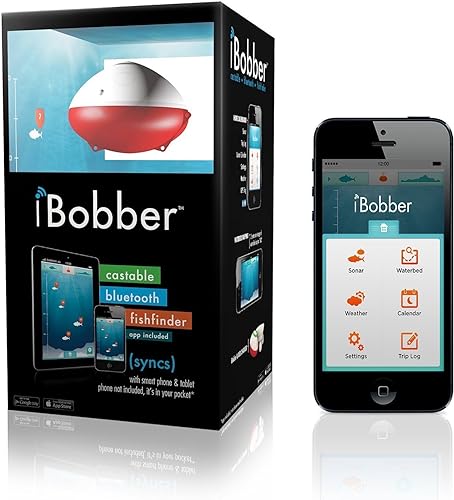
The iBobber is the smallest unit here and the easiest to carry. You cast it on your fishing line and it syncs to the free app on your phone or tablet, so there is no bracket to install and no cable to route.
Bluetooth reaches the app up to 100 ft away.
Depth range reaches 135 ft. It marks fish by size and depth with color-coded icons and shows bottom contours and structure.
Fish and strike alarms tell you when fish gather under a dock or when something takes the bait. The app saves water temperature, depth and spots to a trip log, and you can add lures, species and photos.
ReelSonar says the LED beacon and alarms help with ice fishing and night fishing too. Battery life runs 10+ hours.
Its limit is the phone screen. In bright sun you'll lean on the app's anti-glare setting.
Choose it for shore, docks and kayaks where light gear matters more than a fixed dash display. Buyers who want a screen and mount built in should look at the LUCKYLAKER or Helix 5 instead.
LUCKYLAKER Sonar Kayak Fish Finder: Best for kayaks and canoes
- Wireless transducer with 196 ft range
- 2.4-inch color LCD
- 147 ft depth range
- Fish-attracting lamp
A wireless handheld unit with its own screen, so you can paddle and watch the sonar without a phone in your hand.
Pros
- No cable between transducer and display
- Screen built in, no app needed
- Works in fresh and salt water
Cons
- Short 4–5 hour run time
- Small 2.4-inch screen
The LUCKYLAKER is built for paddlers. Its wireless transducer talks to the display from up to 196 ft away and can be dropped straight into the water or tied to a line.
The 2.4-inch color LCD shows depth, water temperature, bottom contour and fish icons in three sizes. The bottom is drawn in three colors so sand, rock and weed are easier to tell apart.
A rechargeable battery gives 4–5 hours per charge through USB. A lamp inside the transducer attracts fish and helps you see in muddy water or at night.
The depth limit function, sensitivity adjustment and fish alarm round out the features. Simulation mode lets you try every function before you launch.
The small screen is the main compromise. It is fine for depth and fish icons on a kayak, but not for reading structure in detail.
Battery life is also the shortest of the group. Choose it if you paddle and want a screen in your hand; skip it if you fish long days or want mapping.
If your budget is tighter, our fish finders under 200 dollars roundup covers the entry end.
Humminbird Helix 5 CHIRP GPS G3: Best compact boat unit
- Dual Spectrum CHIRP sonar
- Built-in GPS with Humminbird Basemap
- AutoChart Live mapping
- 5-inch color display
A small transom-mount unit that adds GPS, lake maps and live contour mapping to a clear CHIRP sonar picture.
Pros
- Basemap covers 10,000+ lakes
- AutoChart Live builds contours as you go
- Keypad works in rough weather
Cons
- No side imaging at this size
- Smaller screen than the Helix 7
The Helix 5 is the compact version of the Humminbird formula. Its 5-inch color screen takes Dual Spectrum CHIRP sonar with wide and narrow modes, so you can cover water or drill into a mark.
Low-Q transducer design sharpens 2D target separation.
GPS is built in, with Humminbird Basemap covering 10,000+ lakes and the U.S. coast. AutoChart Live records depth contours, bottom hardness and vegetation with eight hours of built-in recording.
LakeMaster, CoastMaster and Navionics cards add premium charts later.
Softkey controls and a simple menu work through weather that would fog a touchscreen. The 5-inch display is the trade-off against the Helix 7: fewer split views and no side imaging.
Pick it for a small boat or a tight helm where GPS matters more than wide scans. It is the cheaper way to get Humminbird mapping into a small space.
JOYWEE FF688C 3.5" Phiradar Color LCD Boat Fish Finder: Best for deep-water budget boats
- Dual frequency 200/83 kHz sonar
- 240 ft depth range
- 3.5-inch color LCD
- Auto zoom and bottom tracking
A low-cost transom unit that reaches deeper than most here and shows bottom type, water temperature and fish size icons.
Pros
- Reaches 240 ft in 1/10th precision
- Dual frequency cuts grass interference
- Auto zoom tracks the bottom
Cons
- Buttons are not waterproof
- No GPS or mapping
The JOYWEE FF688C is the deep-water value pick. Its 200/83 kHz dual frequency reaches 240 ft with readings in 1/10th precision, deeper than any other unit here except the Deeper PRO+ 2.
The 83 kHz beam cuts through grass in lakes, and the display tells sand, rock and weed apart.
The 3.5-inch color screen shows big and small fish icons, fish depth and water temperature. Auto zoom tracks the bottom and manual zoom lets you look closer.
A stop-chart button freezes the picture whenever you want. A depth compensation setting keeps the reading steady and an audible alarm warns you when the bottom rises into shallow water.
The screen is a sunlight-readable 18-bit TFT with a 320 x 240 resolution. The unit runs on DC 10 to 18 volts.
There is no GPS and no mapping, so you mark spots by eye or with a separate GPS. The buttons are not waterproof, so keep a cover on in rain.
Choose it for deep lakes or coastal water on a budget boat. River and shallow-water anglers get more from the FishPRO camera or the iBobber.
Deeper PRO+ 2: Best for mapping unfamiliar water
- Castable Wi-Fi sonar
- Built-in GPS for bathymetric maps
- 330 ft depth range
- Wide, mid and narrow beams
A castable sonar with GPS that builds depth maps you save in the Fish Deeper app, useful for learning a lake from shore or a kayak.
Pros
- Builds bathymetric maps from shore or bank
- Narrow beam separates targets as close as 0.4 in
- Its own Wi-Fi keeps data use low
Cons
- Reads on your phone only
- Castable unit rather than a dash display
The Deeper PRO+ 2 is the mapping tool of the group. Cast it from shore, a dock or a kayak and its built-in GPS builds bathymetric maps saved in the Fish Deeper app.
That makes it the unit to reach for when you're learning a lake before you commit a boat to it.
Its 330 ft range covers deep water. Three beams (wide, mid and narrow) let you scan a wide area or pinpoint a single target; the narrow beam separates objects as close as 0.4 in.
Accuracy holds to 330 ft, and its own Wi-Fi keeps your phone's data free. A night fishing mode helps after dark.
The kit includes two attachment bolts and a neoprene pouch for storage.
The trade-off is that it reads on your phone only. There is no dash display and no keypad.
That suits an angler who scouts from the bank or paddles and wants a saved map to return to. Boat owners who want a fixed screen should pair a Helix unit with it rather than choose one or the other.
The PRO+ 2 covers two years under a limited manufacturer warranty.
Lowrance HOOK Reveal 5 SplitShot: Best for fish-heavy structure
- FishReveal combines CHIRP and DownScan
- SplitShot transducer
- Preloaded C-MAP inland maps
- 5-inch SolarMAX display
FishReveal shows fish and structure in one view, which helps when fish sit tight against cover and a plain sonar arch is hard to read.
Pros
- FishReveal puts fish and cover in one image
- Autotuning adjusts settings as conditions change
- Covers about 4,000 US inland lakes
Cons
- No side imaging
- Map upgrades need a separate card
The Lowrance HOOK Reveal 5 earns its spot on one feature: FishReveal. It blends the target separation of CHIRP sonar with the high-resolution images of DownScan, so fish sitting against structure show up instead of vanishing into the cover.
The SplitShot transducer delivers wide-angle high CHIRP and DownScan below the boat. Autotuning adjusts settings as conditions change, which saves time fiddling with menus.
Preloaded C-MAP maps cover about 4,000 US inland lakes, and Genesis Live builds custom contour maps as you move. The microSD card slot takes C-MAP, Genesis or Navionics upgrades later.
The 5-inch SolarMAX screen stays clear in direct sun. The mounting bracket allows flush or gimbal mounting.
The trade-off against the Humminbird Helix 5 is no side imaging and fewer mapping options without an extra card. Pick it for structure-heavy lakes where you want to see fish and cover together.
Skip it for wide-open trolling where side scans cover more ground.
Deeper Start: Best for dock and bank fishing
- Castable Wi-Fi sonar
- 165 ft cast and depth range
- 40° sonar beam
- Free Fish Deeper app
A simple castable sonar for shore and dock anglers, with a night fishing mode and no cables or external batteries.
Pros
- No wires or external battery
- Saves each scan with time and location
- Night fishing mode
Cons
- No GPS mapping like the PRO+ 2
- 6 hours of battery life per charge
The Deeper Start is the simplest way into castable sonar. Pair it with the Fish Deeper app and you see fish location and size, depth, bottom contour and vegetation within minutes.
There are no wires and no external battery to manage.
It casts and reads to 165 ft with a 40° beam. The unit generates its own Wi-Fi, so it won't eat your mobile data, and it saves every scan with time and location so you can return to a spot.
A night fishing mode helps after dark. It weighs 0.07 kg, light enough to keep in a jacket pocket.
The battery charges in 2.5 hours and runs about 6 hours. It lacks the GPS mapping of the PRO+ 2, so it is a fish finder first and a mapping tool second.
Choose it for casual trips from a dock, bank or kayak; choose the PRO+ 2 when you want contour maps saved to your phone. Casual anglers and family trips are its sweet spot.
How these fish finders under 1000 dollars compare
The table lines up display type, depth range and mounting so you can see at a glance which unit fits your boat. Scores weigh specs and features against what a boat, kayak or ice angler needs most.
| Product | Best for | Display | Max depth | Power | Our score |
|---|---|---|---|---|---|
| FishPRO 2026 Upgrade HD 1080P Underwater Camera | ice fishing | 7-inch IPS | 82 ft | 10,000mAh battery, USB-C | 9.6 |
| ReelSonar iBobber | casting from shore | Phone or tablet app | 135 ft | 9.1 | |
| LUCKYLAKER Sonar Kayak Fish Finder | kayaks and canoes | 2.4-inch color LCD | 147 ft | Rechargeable, 4–5 hours | 8.9 |
| Humminbird Helix 5 CHIRP GPS G3 | compact boat unit | 5-inch color TFT | 8.8 | ||
| Humminbird Helix 7 G4 MEGA Side Imaging | overall | 7-inch color TFT | 125 ft | 8.6 | |
| JOYWEE FF688C 3.5" Phiradar Color LCD Boat Fish Finder | deep-water budget boats | 3.5-inch color LCD | 240 ft | DC 10–18V | 8.6 |
| Deeper PRO+ 2 | mapping unfamiliar water | Phone or tablet app | 100 m (330 ft) | 8.5 | |
| Lowrance HOOK Reveal 5 SplitShot | fish-heavy structure | 5-inch SolarMAX | 7.3 | ||
| Deeper Start | dock and bank fishing | Phone or tablet app | 50 m (165 ft) | 7.2 |
What the comparison table does not show
Sonar type matters more than raw depth for most buyers. CHIRP sonar draws cleaner fish arches than plain sonar.
Imaging sonar adds structure detail. A camera shows a live picture instead of arches.
The units here spread across all three, so match the type to your water before comparing depth numbers. Power and mounting tell the rest of the story: a 10,000mAh camera battery fishes all day, while a 2.4-inch handheld runs a few hours.
A corded 12-volt boat unit never needs a charge at all, as long as your boat has a live circuit.
How we compared these units
We checked each unit's listed display size, sonar type, depth range, mounting, power and mapping features, then weighed them against the water each one suits. A deep-water boat unit and an ice camera are judged by different jobs, so the score reflects fit for its main use as well as raw capability.
Our score weighs specs, features and buyer feedback against what you're shopping for. We did not test these units on the water.
Every spec in this guide comes from the manufacturer's product data.
What sonar type should you choose?
Choose sonar by the water you fish. CHIRP sonar gives clean fish arches and works in most depths.
Imaging sonar reads structure and cover. An underwater camera shows live fish behavior.
Castable units put the sonar on your line and the screen on your phone.
CHIRP sonar
CHIRP sweeps a range of frequencies instead of firing one pulse. The result is better target separation, so two fish close together show as two arches.
The Humminbird Helix 5 and Helix 7 use Dual Spectrum CHIRP. The Lowrance HOOK Reveal 5 uses FishReveal to blend CHIRP with DownScan.
Dual frequency units like the JOYWEE split between 200 kHz for detail and 83 kHz for reach.
Side and down imaging
Side imaging scans out to the sides of the boat and down imaging reads straight below. MEGA Side Imaging on the Helix 7 reaches 125 ft each way.
Use it to find brush piles, drop-offs and docks. DownScan on the Lowrance reads the bottom directly under you.
Imaging is the most productive sonar for structure fishing and the least useful in open water.
Live underwater cameras
A camera drops on a cable and sends a live color picture to a screen. The FishPRO shows fish reacting to your bait in real time.
It is the clearest option for ice fishing and for checking how fish behave. The trade-off is that you watch rather than record.
A camera is also limited to the length of its cable, here 82 ft.
Castable sonar
Castable units like the iBobber, Deeper Start and Deeper PRO+ 2 go out on your line and read on your phone. They are the easiest way to scan from shore.
The PRO+ 2 adds GPS mapping; the Start and iBobber keep it simple. Casting distance and Wi-Fi or Bluetooth range decide how far from your rod you can look.
How much display do you need?
A 3.5 to 5-inch screen is enough for depth and fish icons. A 7-inch screen earns its space when you split views between sonar, imaging and a map.
Bigger is easier to read in sun, but it also takes more dash room.
Small screens for kayaks and tight helms
The JOYWEE FF688C has a 3.5-inch color screen. The LUCKYLAKER uses a 2.4-inch color LCD.
The Humminbird Helix 5 and Lowrance HOOK Reveal 5 each offer a 5-inch display. These fit small boats and paddlers.
The Deeper units and iBobber use your phone's screen instead, which means no extra display to mount.
Large screens for split views
The FishPRO camera has a 7-inch IPS monitor, readable from any angle and with a flip-up sunshade. The Humminbird Helix 7 G4 uses a 7-inch HD screen for split views.
If you plan to run imaging and a map together, go 7 inches. Panel type matters too: IPS holds color and contrast when viewed off-angle, while some budget TN panels lose the picture when you look from above.
Does GPS and mapping matter for your water?
Yes for unfamiliar water. GPS lets you mark waypoints and return to productive spots.
Mapping shows depth contours before you drop a line. If you fish the same small lake every weekend, a sonar-only unit like the JOYWEE FF688C is enough.
Built-in GPS units
The Humminbird Helix 5 and Helix 7 both include GPS and Humminbird Basemap, plus AutoChart Live for building your own contour maps. The Deeper PRO+ 2 builds bathymetric maps on your phone.
These are the units to shortlist when spots need marking. The Lowrance adds preloaded C-MAP maps for about 4,000 inland lakes plus Genesis Live.
Sonar-only units
The JOYWEE FF688C and LUCKYLAKER read depth, fish and bottom without GPS. The FishPRO camera shows a picture with no mapping.
Choose these when price matters more than returning to a spot, or when you already have a GPS on board. A separate handheld GPS plus a sonar-only unit can cost less than one mapping unit, though you lose the live contour overlay.
What should you check before mounting a unit?
Check the mounting type against your hull and dash first. Transom-mount units need room at the back of the boat.
Gimbal and in-dash units need helm space. Wireless and castable units need nothing but your phone.
Transom and dash mounting
The Humminbird Helix 5 and Helix 7 ship with transom-mount transducers and gimbal brackets. The Helix 7 also fits in-dash mounting.
The JOYWEE and Lowrance units mount on the surface or flush. Measure your helm before ordering.
The transducer cable route matters as much as the head unit, so plan where it will pass through the hull.
Wireless and castable options
The LUCKYLAKER transducer needs no bracket; tie it to a line or drop it in the water. The iBobber and both Deeper units go out on a cast.
These suit kayaks, canoes and shore anglers who do not want to drill the hull. Castable units are also easy to move between boats and craft from trip to trip.
Verdict: which fish finder under 1,000 dollars should you buy?
For most boat anglers, the Humminbird Helix 7 G4 MEGA Side Imaging is the best fish finder under 1000 dollars. Its 7-inch screen, side imaging to 125 ft and built-in GPS cover the widest range of fishing days.
It finds structure that a plain sonar arch misses.
Pick by water and craft. The FishPRO camera wins for ice fishing and live viewing.
The iBobber and Deeper Start suit shore and dock anglers. The Deeper PRO+ 2 is the mapper's choice.
The LUCKYLAKER fits kayaks. The Humminbird Helix 5 packs GPS into a small helm.
The JOYWEE FF688C and Lowrance HOOK Reveal 5 round out deep-water and structure work.
Set your budget, choose the sonar type for your water, then check mounting space. That order gets you a unit you'll actually use.
Our top 3 picks at a glance
-
1
Best for ice fishing
FishPRO 2026 Upgrade HD 1080P Underwater Camera
9.6/10 our score
See it on Amazon -
2
-
3
Frequently asked questions
Do I need a fish finder with GPS?
Yes if you fish unfamiliar water or want to return to a productive spot. GPS lets you mark waypoints and build contour maps, as the Humminbird Helix 5, Helix 7 and Deeper PRO+ 2 all do.
A sonar-only unit is fine for small lakes you know well.
Is side imaging worth it on a boat?
It is if you hunt structure like brush piles, drop-offs and docks rather than open water. MEGA Side Imaging on the Helix 7 scans 125 ft to each side of the boat.
For simple depth and fish arches, a CHIRP unit like the Helix 5 does the job.
Can I use a castable fish finder from a boat?
Yes. Castable units like the Deeper PRO+ 2 and iBobber work from a boat, kayak or shore, and you read the sonar on your phone.
A mounted unit gives you a dedicated screen, but the castable ones are easier to move between craft.
What should I check before mounting a fish finder on my boat?
Check the transducer mounting type and the screen size against your dash space. Transom-mount units like the Humminbird and JOYWEE models need room at the back of the hull.
Gimbal and in-dash options fit tighter helms.