7 Best Entry Level Fish Finders (November 2026)
The best entry level fish finders include the ReelSonar iBobber for shore and dock casting, the LUCKY Portable Handheld Fish Finder for a built-in color screen, and the Deeper PRO+ 2 for mapping and GPS.
On this page (10 sections)
- The best entry level fish finders by use
- How these entry level fish finders compare
- How we compared these fish finders
- What depth range does a beginner actually need?
- Should you pick a castable sonar or a screen unit?
- What screen and mounting choices matter most?
- How long do the batteries last on a beginner fish finder?
- Which entry level fish finder fits river fishing?
- Do you need GPS on a first fish finder?
- Verdict: which entry level fish finder should you buy?
The best entry level fish finder for most people is the ReelSonar iBobber, because it casts from shore or dock, reads to 135 ft and runs 10+ hours on a charge. If you'd rather not tie your fishing to a phone, the LUCKY portable handheld gives you a color screen and a wired transducer for a modest step up in price.
Entry level covers a lot of ground. For one angler it means a pocket sonar cast from a riverbank; for another it means a small screen bolted to a kayak or jon boat.
This list sorts the choices by what a beginner actually needs on the water.
If you're just starting out and want the wider context, our guide to the best fish finders for beginners covers the terms and features first. The picks below stay within the best entry level fish finder range: simple to set up, readable, and without the pro-grade price.
Our picks at a glance
-
1
-
2
 Best for a built-in color screen
LUCKY Portable Handheld Fish Finder
8.6/10 our score
See it on Amazon -
3

- 4
 Best for kayak and ice useCheck it
- 5
 Best for ice fishing and flasher readoutsCheck it
- 6
 Check it
Humminbird PiranhaMAX 4 Portable
Best for a kit you can carry aboard - 7
 Best for low-cost phone sonarCheck it
The best entry level fish finders by use
The iBobber is the best overall choice, while each pick below is the best fit for a specific way of fishing. Match the unit to where you fish and what you'll carry before comparing screen sizes.
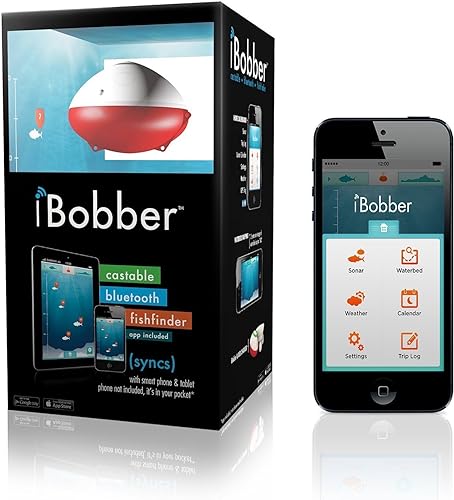
ReelSonar iBobber: Best for shore and dock casting
- 135 ft maximum depth
- 10+ hours per charge
- Bluetooth app for iOS and Android
- Fish and strike alarms
A castable sonar you clip to your line and read on your phone. It suits bank and dock anglers who want a depth reading without wiring a transducer to a boat.
Pros
- Castable from shore or dock
- 135 ft depth range
- Fish and strike alarms
- Maps waterbed and trip log in the app
Cons
- Needs a charged phone within Bluetooth range
- LCD figure is the phone display, not an onboard screen
The iBobber suits the angler who fishes from a bank, pier or dock without a boat to mount anything on. Clip it to your line, cast it out, and the sonar sends depth, bottom contours and fish icons to the free app on your phone over Bluetooth.
The depth-tagged fish icons are color coded by size, so you get a quick sense of what's below without learning to read raw sonar. A fish alarm tells you when fish gather under docks and piers, and the strike alert can flag a bite.
That combination is useful for night and ice trips too.
Battery life of 10+ hours covers a long session. The app also logs water temperature, depth and trip notes, and lets you mark spots.
The trade-off is the reliance on your phone. Keep a charge in the device and in the phone.
Pick it if you fish from shore; skip it if you want a screen on the unit itself.
LUCKY Portable Handheld Fish Finder: Best for a built-in color screen
- 2.4 in color TFT LCD
- 328 ft depth detection
- 45 degree beam at 200 kHz
- 26 ft wired transducer distance
A handheld unit with its own screen and a wired transducer. You get depth, water temperature, bottom contour and fish size without pairing a phone.
Pros
- Own color screen and controls
- 328 ft depth detection
- Simulation mode to practice
- Adjustable sensitivity and alarms
Cons
- Wired transducer needs a mount or hand placement
- About 5 hours per full charge
The LUCKY portable handheld is the best fit for a beginner who wants everything in one hand. It has its own 2.4 in color TFT LCD, so depth, water temperature, fish size and fish depth all show on the unit.
A 45 degree beam at 200 kHz and a 328 ft detection range put it well past what most inland fishing needs. The transducer connects by a 26 ft cable, so you can place it off the side of a kayak or boat and still read the screen.
Simulation mode is a nice beginner feature: practice the menus and alarms on dry land before your first trip. Sensitivity, screen brightness, depth range, zoom and the fish and depth alarms are all adjustable.
It runs about 5 hours on a full charge. Pick it for a self-contained unit; skip it if you prefer a wireless castable that works from shore without a mount.
Deeper PRO+ 2: Best for mapping and GPS
- Built-in GPS for bathymetric maps
- 330 ft depth accuracy
- Wi-Fi connection to the Fish Deeper app
- Wide, mid and narrow beams
A castable sonar with GPS that saves depth maps to the app. It suits an angler who wants to build a picture of a lake or stretch of river over several trips.
Pros
- Built-in GPS
- Bathymetric maps saved to the app
- Three beam choices
- 0.4 in target separation on narrow beam
Cons
- Costs more than a basic sonar
- Map features lean on the app rather than an onboard screen
The Deeper PRO+ 2 is the best entry level fish finder if you plan to learn a piece of water properly. Its built-in GPS saves bathymetric maps to the Fish Deeper app, so you can build a depth picture of a lake, dock or river bend across several trips.
Deeper's marketing claims accuracy at up to 330 ft. Wide, mid and narrow beam options let you cover open water or drill into a specific spot, and target separation of 0.4 in on the narrow beam helps when you're vertical jigging.
The Wi-Fi link to the app means no data plan needed. You get a dependable connection and the maps stay saved for revisits.
This is the highest-spec unit here and the most expensive. The extra mapping is worth it only if you'll return to the same water.
Pick it for lake study; skip it if a single depth reading is all you need.
Yoocylii Handheld Fish Finder: Best for kayak and ice use
- 3 ft to 328 ft depth range
- 45 degree beam at 200 kHz
- Neck strap included
- Runs on 4 AAA batteries
A small round-screen handheld that reads depth and rough fish position. It hangs from a neck strap while you paddle or drill holes, and takes standard AAA batteries.
Pros
- Neck strap keeps hands free
- Works in fresh and salt water
- Finds weeds, rock and sand on bottom
- Runs on 4 AAA batteries
Cons
- Batteries not included
- Battery life is 4 to 5 hours in continuous use
The Yoocylii handheld suits kayak and ice anglers who want a screen that hangs out of the way. A neck strap keeps it close while your hands stay on the paddle or the auger.
It uses sonar at 200 kHz with a 45 degree beam and reads from 3 ft down to 328 ft. The round LCD shows water depth, approximate fish location, fish size and whether the bottom is weeds, sand or rock.
It runs on 4 AAA batteries for 4 to 5 hours of continuous use, so carry a spare set. Five sensitivity levels, a battery save mode and a backlight are all adjustable, and the settings are saved when the unit turns off.
For kayak use, Yoocylii notes the transducer should sit horizontal and the kayak should move below 5 mph. Pick it for portability; skip it if a wired cable in a small boat bothers you.
Hawkeye FishPod 5x: Best for ice fishing and flasher readouts
- Bluetooth to your phone
- 199 ft maximum depth
- Four preset operating modes
- Vertical flasher mode
A Bluetooth bobber that streams sonar to your phone. The vertical flasher and preset modes make it a good fit for ice fishing and quick reads from a dock.
Pros
- Vertical flasher for ice fishing
- FishEcho filters clutter
- TraxNut mount fits 1/4 x 20 brackets
- BottomScan reads weed vs hard or soft bottom
Cons
- 199 ft depth cap is shallower than some picks here
- Needs your phone at the hole
The Hawkeye FishPod 5x is the best fit for ice fishing and for anglers who like a flasher readout. Its vertical flasher mode amplifies recent sonar echoes, which is exactly what you watch over a hole in winter.
It streams to your phone over Bluetooth and reads to 199 ft. Four preset modes auto-adjust the screen settings for fish size, depth or schooling, and FishEcho tunes the sonar to cut out clutter and false echoes.
BottomScan reads bottom contour and composition so you can tell vegetation from soft or hard seabed. The TraxNut mount fits any 1/4 x 20 bracket, so it works on a variety of platforms.
The 199 ft cap is shallower than the LUCKY and Yoocylii here, which matters in deep lakes but not in most ice and river fishing. Pick it for winter trips; skip it for deep-water work.
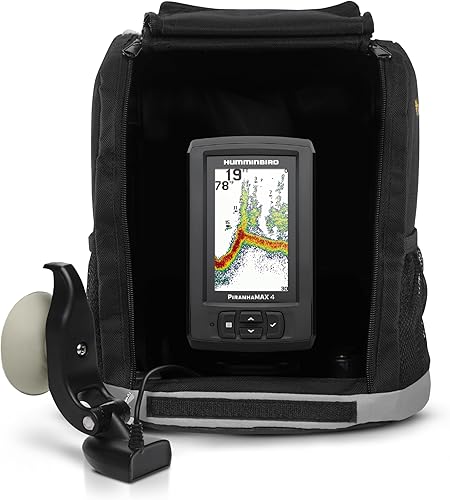
Humminbird PiranhaMAX 4 Portable: Best for a kit you can carry aboard
- 4.3 in color TFT display
- Dual beam sonar
- Soft-sided carrying case
- 7 Ah battery and charger included
A portable kit built around a 4.3 in color screen. The case, portable transducer, battery and charger all ship together, so you can move the whole setup between boats.
Pros
- Everything needed in one case
- Dual beam for detail or coverage
- Tilt and swivel mount
- Humminbird provides a 1-year limited warranty
Cons
- A full kit weighs 2.5 lb with the battery
- Higher price tier than the handhelds here
The Humminbird PiranhaMAX 4 Portable is the best fit for a beginner moving between boats. The soft-sided case holds the 4.3 in color TFT screen, a portable transducer, a 7 Ah battery and a wall charger, so there's no separate wiring job each trip.
Dual beam sonar lets you pick a narrow beam for detail or a wide one for coverage. That's useful when you're learning to read structure and fish marks at the same time.
The tilt and swivel mount adjusts your viewing angle quickly. Fish ID+, fish alarms, depth alarms and zoom are all there, and Humminbird provides a 1-year limited warranty.
It's a bigger kit than the handhelds: 2.5 lb with the battery, and a higher price tier. Pick it if you want a real mounted screen; skip it if you hike or wade to your spots.
Deeper Start: Best for low-cost phone sonar
- 165 ft cast and depth range
- 40 degree sonar beam
- Wi-Fi to the Fish Deeper app
- About 6 hours per charge
A simple castable sonar for shore and bank fishing. It sends depth, fish location and bottom contour to a free app over its own Wi-Fi.
Pros
- Casts and reads to 165 ft
- Night fishing mode
- About 6 hours of battery life
- Saves each scan with time and location
Cons
- No GPS or bathymetric mapping
- 40 degree beam is narrower than the PRO+ 2's options
The Deeper Start is the best low-cost way into phone sonar. It casts out to 165 ft and reads down to 165 ft with a 40 degree beam, then sends the picture to the Fish Deeper app over its own Wi-Fi.
Pair it with your phone and you see fish location and size, depth, bottom contour and vegetation. Each scan saves with time and location so you can revisit a spot.
A night fishing mode helps after dark.
It charges in about 2.5 hours and runs about 6 hours, long enough for a casual outing. The app is free and works on iOS and Android.
It has no GPS or bathymetric mapping, so it's a read-it-now tool rather than a lake-mapping one. Pick it for shore trips on a budget; skip it if you want maps or a built-in screen.
How these entry level fish finders compare
The table puts the main specs side by side: depth, screen type, mounting and power. Use it to narrow the field before reading the write-ups in detail.
| Product | Best for | Max depth | Mounting | Power | Our score |
|---|---|---|---|---|---|
| ReelSonar iBobber | shore and dock casting | 135 ft | Fishing line | Rechargeable battery | 9.1 |
| LUCKY Portable Handheld Fish Finder | a built-in color screen | 328 ft | Rechargeable, about 5 hours | 8.6 | |
| Deeper PRO+ 2 | mapping and GPS | 328 ft | Surface mount or castable | Rechargeable battery | 8.5 |
| Yoocylii Handheld Fish Finder | kayak and ice use | 328 ft | 4 AAA batteries, 4 to 5 hours | 8.2 | |
| Hawkeye FishPod 5x | ice fishing and flasher readouts | 199 ft | Universal 1/4 x 20 bracket | Rechargeable battery | 8.0 |
| Humminbird PiranhaMAX 4 Portable | a kit you can carry aboard | Surface mount, tilt and swivel | 7 Ah battery included | 7.7 | |
| Deeper Start | low-cost phone sonar | 165 ft | Handheld or castable | Rechargeable, about 6 hours | 7.2 |
How we compared these fish finders
We compared the specs and features each brand publishes and weighed them against what a beginner actually uses on the water: depth reading, screen clarity, mounting options, battery life and how quickly you can get a reading.
Our score weighs specs, features and buyer feedback against what you're shopping for. Depth range counted heavily, but so did portability and whether a unit needs a phone or a mount to work.
We gave extra weight to entry-level simplicity, so a unit that reads depth and fish without a steep learning curve ranked above one packed with pro features you may never use.
Scores are set once per product and carried across the site.
Prices and review counts change, so we leave them out.
What depth range does a beginner actually need?
For most freshwater fishing, a finder that reads to 135 ft covers everything you'll encounter. The iBobber's 135 ft range handles ponds, rivers, docks and most lakes.
Deep reservoirs and Great Lakes fishing push past that. The LUCKY and Yoocylii both read to 328 ft, and Deeper's marketing claims accuracy at up to 330 ft for the PRO+ 2.
If you fish water deeper than about 100 ft regularly, choose one of those.
The number matters less than how clearly the unit shows what's below. A 135 ft castable with color-coded fish icons can tell you more about a brush pile in 12 ft of water than a deeper unit with a cluttered screen.
Should you pick a castable sonar or a screen unit?
A castable sonar is the easier first buy if you fish from shore, a dock or a pier. You clip it to your line, cast, and read the app.
There's no transducer to mount and no wiring to plan.
A screen unit is the better fit if you fish from a boat or kayak and want the reading in front of you. The LUCKY, Yoocylii and PiranhaMAX 4 all have their own displays.
That means no phone battery to watch and no Bluetooth pairing at the water.
Here's the decision rule. Pick castable if your feet stay on land; pick a screen unit if you're on the water and want a permanent view.
A hybrid like the FishPod 5x splits the difference with a phone app and a mount.
Castable and app-based options
The iBobber and the two Deeper models cast from shore or bank. The iBobber reads to 135 ft with a 10+ hour battery.
The Deeper Start reads to 165 ft with about 6 hours. The PRO+ 2 reads to 328 ft and adds GPS mapping.
Screen and mounted options
The LUCKY, Yoocylii and PiranhaMAX 4 put the reading on the unit. The LUCKY and Yoocylii run on internal or AAA batteries and are hand-held.
The PiranhaMAX 4 kit includes a 7 Ah battery, charger and case for a semi-permanent boat setup.
What screen and mounting choices matter most?
Screen size and mounting decide how often you'll actually look at the finder. A screen you have to squint at or a mount that shifts will get ignored after the first trip.
Screen size runs from the 2.4 in LUCKY to the 4.3 in PiranhaMAX 4. A bigger color screen is easier to read in sunlight, but it adds weight.
The handhelds trade screen size for portability.
Mounting matters just as much. The PiranhaMAX 4 uses a tilt and swivel mount, so you can angle the screen.
The FishPod 5x fits any 1/4 x 20 bracket. Castable units need no mount at all.
Matching a mount to your boat
Kayak anglers often want a small bracket or a neck strap. The Yoocylii's neck strap keeps the screen within reach while you paddle.
The FishPod 5x's TraxNut mount attaches to standard brackets.
For a jon boat or pontoon, a surface mount and a proper transducer placement make the screen easy to watch. Our guide to the best fish finders for a pontoon boat covers placement on wider decks.
Reading the screen in daylight
Color TFT screens like the LUCKY's and PiranhaMAX 4's are easier to read in bright light. The iBobber's app has an anti-glare setting for the same problem.
If you fish midday in open water, prioritize screen brightness and a glare setting.
How long do the batteries last on a beginner fish finder?
Battery life ranges from about 4 hours to 10+ hours depending on the unit and how you run it. Plan your session around that number and carry a backup where you can.
The iBobber leads with 10+ hours on a charge. The Deeper Start runs about 6 hours.
The LUCKY manages about 5 hours, and the Yoocylii runs 4 to 5 hours on 4 AAA batteries.
AAA batteries are easy to swap mid-trip, while rechargeable units need a power source or a power bank. If you fish long days or off-grid, the Yoocylii's standard batteries are an advantage.
If you'd rather charge at home, the iBobber or Deeper models are simpler.
Cold weather drains batteries faster. For ice fishing, carry a spare set or a power bank, and keep the unit warm between holes where you can.
Which entry level fish finder fits river fishing?
River fishing favors a unit that casts easily and reads bottom contour in moving water. A castable sonar like the iBobber or Deeper Start is the natural fit.
The iBobber's fish and strike alarms help when the current moves your line and you can't watch the app constantly. It also maps bottom contours, which matters in rivers where channels and holes hold fish.
The LUCKY's 45 degree beam and 328 ft range work from a boat or kayak in deeper stretches. For more on reading moving water, see our guide to the best fish finders for river fishing.
Shore and bank casting on rivers
Castable units shine here. You cast upstream or across, let the sonar read as it drifts or sinks, and watch the app.
The iBobber's 135 ft range is plenty for most rivers.
Boat and kayak work on rivers
If you're anchored or drifting in a boat, a screen unit keeps the reading in view. The LUCKY's color screen and adjustable depth range help as the bottom changes under you.
Do you need GPS on a first fish finder?
No. GPS is a nice extra, not a beginner requirement.
A plain depth and fish reading gets you on fish, and you can upgrade to mapping once you know how you fish.
The PRO+ 2 is the only pick here with built-in GPS, and it's what lets you build bathymetric maps. That's a real advantage on big water you revisit, but it adds cost and complexity.
If you fish a handful of small spots and know them well, skip GPS for now. If you're learning a large lake, our guide to the best fish finder with GPS explains what the mapping features add.
Verdict: which entry level fish finder should you buy?
The best entry level fish finder for most anglers is the ReelSonar iBobber. It casts from shore or dock, reads to 135 ft and runs 10+ hours, so you get real sonar without mounting anything or spending a lot.
Pick the LUCKY portable handheld if you want your own color screen and no phone. Pick the Deeper PRO+ 2 if you plan to map a lake over several trips.
For ice fishing, the Hawkeye FishPod 5x and its vertical flasher are the fit. And if you fish from a boat and want a full kit in a case, the Humminbird PiranhaMAX 4 Portable is the one to carry aboard.
Start with your water and your feet: on land, go castable; on a boat or kayak, go with a screen. Either way, a simple unit that reads depth and fish clearly will teach you more than a feature list.
Our top 3 picks at a glance
-
1
-
2
Best for a built-in color screen
LUCKY Portable Handheld Fish Finder
8.6/10 our score
See it on Amazon -
3
Frequently asked questions
What is the best entry level fish finder overall?
The ReelSonar iBobber is the best entry level fish finder for most people. It casts from shore or dock, reads to 135 ft and runs 10+ hours per charge.
Pair it with your phone to see depth, bottom contours and fish icons.
Do entry level fish finders need a phone?
Not all of them. Castable units like the iBobber and Deeper models send sonar to a phone app over Bluetooth or Wi-Fi.
Handheld units like the LUCKY and Yoocylii have their own screens.
Pick a screen model if you fish without a charged phone nearby.
How deep can a beginner fish finder read?
The picks here read from about 135 ft to 328 ft, depending on the model. Deeper says the PRO+ 2 is accurate to 330 ft, while the LUCKY and Yoocylii both detect to 328 ft.
Most freshwater fishing happens well inside those ranges.
Can I use an entry level fish finder for ice fishing?
Yes, several work through the ice. The Hawkeye FishPod 5x has a vertical flasher mode made for it, and the iBobber's fish and strike alarms suit night and ice trips.
The Yoocylii also lists ice fishing as a use.
What should I skip when buying a first fish finder?
Skip extra mapping and GPS features if you fish the same small water every week. Start with a unit that reads depth and shows fish clearly, then upgrade once you know how you use it.
A basic sonar does most of the job.