9 Best Portable Fish Finders for Small Boats (November 2026)
The best portable fish finders for small boats include the ReelSonar iBobber (best overall), the LUCKYLAKER Sonar Kayak Fish Finder for a wireless screen, and the Humminbird Helix 5 CHIRP GPS G3 for charting lakes.
On this page (6 sections)
- The best portable fish finders for small boats, ranked
- How these portable fish finders compare
- How we compared these portable fish finders
- What should you check before buying a portable fish finder?
- Which portable fish finder fits your small boat?
- The verdict on the best portable fish finder for small boats
The best portable fish finder for a small boat is the ReelSonar iBobber, a castable wireless sonar that needs no bracket and runs 10+ hours on a charge. If you want your own screen instead of a phone, the LUCKYLAKER gives you a wireless color display.
For lake charts and sonar together, go with the Humminbird Helix 5 CHIRP GPS G3.
A small boat leaves little room for a fixed console unit. The best portable fish finder for a small boat has to set up fast, pack away small and read clearly in sun or rain.
The nine picks below cover castable sonar, wireless handhelds, wired transducers and one full chartplotter kit.
Our picks at a glance
-
1
-
2

-
3

- 4
 Check it
LUCKY Portable Fish Finders Wired Transducer
Best for deep water - 5
 Check it
LUCKY Portable Fish Finder Handheld
Best for fishing at night - 6
 Best for mapping from shoreCheck it
- 7
 Best for the tightest budgetCheck it
- 8
 Check it
Humminbird PiranhaMAX 4 Portable
Best for carrying in a case - 9
 Best for beginnersCheck it
The best portable fish finders for small boats, ranked
Each pick suits a different kind of small boat and a different way of fishing. Start with the iBobber for most trips, then move down the list if you need a dedicated screen, GPS maps or more depth.
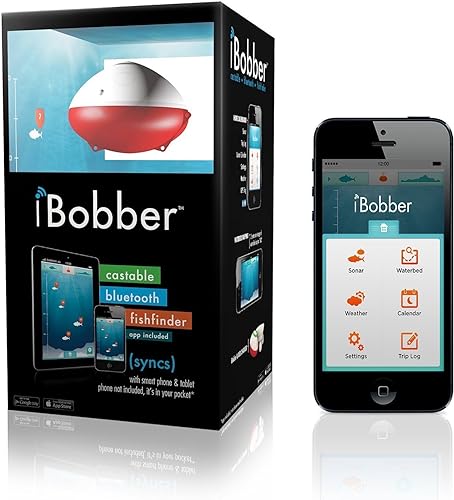
ReelSonar iBobber: Best overall
- Castable wireless sonar
- 135 ft depth range
- 10+ hours battery life
- Bluetooth to iOS and Android
A pocket-sized sonar you cast from shore or boat and read on your phone. The long battery life and fish alarms suit quick trips in a small hull.
Pros
- Castable design needs no mounting hardware
- 135 ft depth range
- Fish and strike alarms
- 10+ hours of battery life
Cons
- Reads on your phone rather than its own screen
- Needs the app for every feature
The iBobber is a pocket-sized sonar you tie to a line and cast. It syncs to your phone or tablet over Bluetooth, so there is no bracket to bolt on and nothing to mount at the transom.
Its 135 ft depth range covers most lakes, ponds and inshore water a small boat fishes. The app turns the sonar returns into depth-tagged fish icons color coded by size, plus a view of the bottom and any structure.
Because it casts out from where you stand, it reads water your hull can't reach without moving the boat.
Battery life is where it pulls ahead. ReelSonar says it runs 10+ hours on a charge, which covers a full day without a spare power pack.
Fish and strike alarms help when you're watching the water rather than the screen, and the LED beacon makes the unit easier to spot at night or on ice. The free app also maps waterbeds, marks spots and logs water temps, lures and species in a trip log.
The trade-off is that your phone becomes the display. That suits a boat with no dash, but it means keeping your phone charged and shaded.
Pick it for casting from a dinghy or shore and checking depth as you drift.
LUCKYLAKER Sonar Kayak Fish Finder: Best for a wireless screen
- 196 ft wireless operating range
- 147 ft depth range
- 2.4 in color LCD
- 4-5 hours per charge
A wireless transducer talks to a separate color screen, so you get a dedicated display without running a cable along the boat.
Pros
- Wireless transducer with its own screen
- 196 ft wireless range
- Color screen shows bottom contour
- Attractant lamp
Cons
- 4-5 hours per charge
- Two parts to keep track of
LUCKYLAKER takes a different route: a wireless transducer talks to a separate 2.4 in color screen. You get a dedicated display with no cable running from the transducer to the unit.
The wireless operating range reaches 196 ft and the depth reading reaches 147 ft. The color screen shows bottom contour in three colors and marks fish as large, medium or small icons.
It also shows water temperature and has a depth limit and sensitivity adjustment, plus an alert when fish or schools are nearby.
A rechargeable battery gives 4-5 hours per charge, so plan on a mid-day top-up or a second outing's worth of power. The transducer includes an attractant lamp that LUCKYLAKER says draws fish and helps in muddy water, and a simulation mode lets you try every function before you fish.
This is the pick for an angler who wants a real screen on a boat too small for a fixed unit. It suits kayaks and skiffs where a cable would snag.
The shorter battery life against the iBobber is the main reason it sits in second place.
Humminbird Helix 5 CHIRP GPS G3: Best for charting lakes
- Dual Spectrum CHIRP sonar
- Built-in Humminbird Basemap
- AutoChart Live mapping
- 5 in color TFT display
Sonar and GPS in one unit, with basemaps for 10,000+ lakes and live contour mapping while you move across the water.
Pros
- Built-in GPS with basemaps
- AutoChart Live contour mapping
- Wide and narrow CHIRP modes
- Keypad controls work in weather
Cons
- Needs a transom mount and 12V power
- Least portable castable-free pick here
The Humminbird Helix 5 CHIRP GPS G3 is the most capable unit here, and the least portable. It combines sonar and GPS in one head unit with a 5 in color display.
Its Dual Spectrum CHIRP sonar gives wide and narrow modes, so you can cover water fast or pick apart a small piece of structure. The Low-Q transducer sharpens 2D target separation.
The built-in Humminbird Basemap covers 10,000+ lakes and U.S. coastlines and accepts LakeMaster, CoastMaster and Navionics charts.
AutoChart Live records depth contours, bottom hardness and vegetation as you move, with 8 hours of built-in recording and support for Zero Line SD cards. Keypad controls work in wet weather in a way touchscreens often don't.
The catch is that it needs a transom mount and 12V power, so it's portable in the sense that you can move it between boats, not that you can carry it in a tackle bag. The box includes the XNT 9 HW T transom transducer, the gimbal bracket and the power cable.
Pick it for a small boat that still has a battery and a spot for a bracket.
LUCKY Portable Fish Finders Wired Transducer: Best for deep water
- 328 ft depth range
- 45 degree beam
- 25 ft wired transducer cable
- Runs on 4 AAA batteries
A wired sonar with the deepest range in this group. The long cable lets you trail the transducer over the side from a small boat.
Pros
- 328 ft detecting depth
- 25 ft transducer cable
- Backlight for night fishing
- Battery save mode
Cons
- Wired cable to manage on deck
- Basic 2 in display
The LUCKY wired transducer model offers the deepest range in this roundup. It reads from 3 ft down to 328 ft with a 45 degree beam, so deep lakes and offshore structure are within reach.
The transducer runs on a 25 ft cable, which lets you trail it over the side or tie it near the hull. A 2 in LCD shows fish, bottom type such as weeds, sand or rocks, and water depth, and the backlight helps after dark.
It runs on 4 AAA batteries with a battery save mode for longer trips. Sensitivity, fish and school alarms and the battery indicator are adjustable from the unit, and you can switch depth units between meters and feet with a long press.
The wire is the trade-off. It has to be managed on deck and kept clear of the prop.
Pick this when depth matters more than convenience, such as deep trolling from a small boat.
LUCKY Portable Fish Finder Handheld: Best for fishing at night
- 2.4 in color LCD
- 328 ft depth range
- Water temperature display
- Rechargeable battery
A handheld screen with a wired transducer that shows depth, water temperature and fish size. The adjustable brightness helps in low light.
Pros
- Shows water temperature
- 328 ft depth range
- Brightness adjustable for night or sun
- Three bottom contour views
Cons
- Wired transducer and cable
- About 5 hours per charge
This LUCKY handheld adds water temperature to the readout, which matters when you're tracking a thermocline in a small lake. The 2.4 in color screen shows fish size and depth plus three bottom contour views.
Its depth range reaches 328 ft and it uses a 26 ft wired transducer with a 45 degree beam at 200 kHz. Screen brightness adjusts so you can read the display in full sun or at night, and units can be switched between feet and meters and between Celsius and Fahrenheit.
It recharges over USB and runs about 5 hours on a full charge. Sensitivity, depth range, zoom and fish icon settings are all adjustable, and a bracket lets you attach the transducer to a boat or kayak.
The screen is bigger and brighter than the wired LUCKY model above, but the depth ceiling is the same. Pick it when you want temperature and a brighter screen in one handheld.
Deeper PRO+ 2: Best for mapping from shore
- Castable Wi-Fi sonar
- Built-in GPS
- 330 ft accuracy
- Narrow, mid and wide beams
Cast it from the bank or boat and build bathymetric maps in the app. The beam choices help cover water fast or drill into a spot.
Pros
- Built-in GPS for lake maps
- Three beam widths
- 330 ft accuracy
- Wi-Fi connection to your phone
Cons
- Premium pick
- Maps and features live in the app
The Deeper PRO+ 2 is a castable Wi-Fi sonar with built-in GPS. You cast it from the bank or boat and build bathymetric maps in the Fish Deeper app.
Its accuracy reaches 330 ft. Narrow, mid and wide beams let you cover open water or drill down on a single spot, and target separation of 0.4 in in narrow beam tracks even small lures when you jig straight down.
The wide and mid beams separate targets at 1 in.
Built-in GPS means you can map a lake from shore without anchoring the boat. Wi-Fi connectivity keeps the link to your phone steady, and the package includes a neoprene pouch and attachment bolts for mounting on a boat.
Maps save to the app for later trips.
This is the premium castable option. It asks you to fish through an app, and it is the most feature-rich sonar here.
Pick it if mapping unfamiliar water matters more than a simple depth readout.
Yoocylii Handheld Fish Finder: Best for the tightest budget
- 328 ft depth range
- 45 degree beam
- Neck strap included
- Runs on 4 AAA batteries
A simple handheld unit with a tossable transducer. The neck strap and small body suit casting from a crowded small boat.
Pros
- Neck strap keeps hands free
- 328 ft depth range
- Works in fresh and salt water
- Battery save mode
Cons
- Basic LCD
- 4-5 hours on fresh batteries
The Yoocylii is the simplest way into sonar on a small boat. It's a handheld display with a tossable transducer on a 25 ft cable and a neck strap to keep your hands free.
It reads depth from 3 ft to 328 ft with a 45 degree beam. The screen shows fish size, fish depth, bottom type such as grass, rock or sand, and the unit works in fresh or salt water.
The operating temperature range runs from 14°F to 113°F.
It runs on 4 AAA batteries for 4-5 hours. Five sensitivity levels, a backlight and a fish alarm cover the basics without menus to learn, and the settings are saved when the unit is switched off.
The manufacturer covers it with a 2 year warranty.
The package includes a removable transducer float, a side-scan adapter and a stainless bolt and wing nut for mounting the sensor to a boat. The display is basic compared with the color screens above.
Pick it if you want an inexpensive first finder and don't need maps or wireless range.
Humminbird PiranhaMAX 4 Portable: Best for carrying in a case
- Dual Beam sonar
- Soft-sided carrying case
- 7 Ah battery and charger
- 4.3 in color LCD
A full sonar unit packed in a carry case with its own battery. It sets up and packs away as one kit.
Pros
- Comes as a complete portable kit
- Dual Beam sonar
- 4.3 in color screen
- Tilt and swivel mount
Cons
- Bulkiest option here
- Needs the case and battery to travel
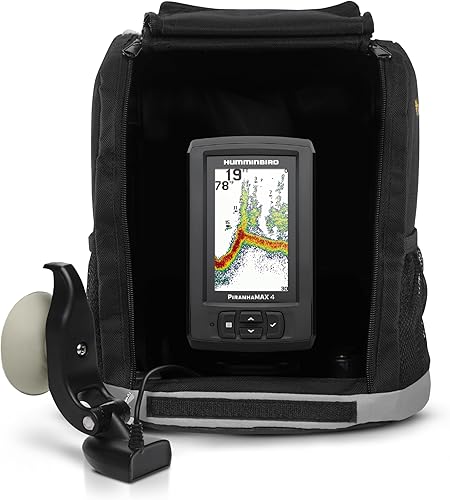
The Humminbird PiranhaMAX 4 Portable comes as a kit: the finder, a soft-sided carrying case, a portable transducer, a 7 Ah battery and a wall charger. You carry it as one bundle and set it up where you fish.
Its Dual Beam sonar offers a narrow beam for detail and a wide beam for coverage. The 4.3 in color screen sits on a tilt and swivel mount so you can angle it to the sun, and Fish ID+, fish alarms, depth alarms and zoom are all in the menu.
The portable transducer uses a suction cup to stick to the hull, so you can move it between boats without drilling holes. The 7 Ah battery is a sealed pack with its own charger, which is a big step up from AAA cells in run time.
This is the pick for an angler who moves the same unit between a small boat and a dock. The case protects the screen and holds the battery.
The bulk is the trade-off. It's the biggest option in this group and needs the case and battery to travel.
Pick it when you want a full color unit that packs like a kit.
Deeper Start: Best for beginners
- Castable Wi-Fi sonar
- 165 ft cast and depth
- 40 degree beam
- 6 hours battery life
A simple castable sonar that pairs with the Fish Deeper app. It covers shallow to mid-depth water at a low entry point.
Pros
- Simple app setup
- 165 ft cast and depth range
- 6 hours of battery life
- Night fishing mode
Cons
- 40 degree beam only
- Fewer features than the PRO+ 2
The Deeper Start is the entry point to castable sonar. Cast it from a dock, bank or kayak and pair with the Fish Deeper app to see fish location, size and depth.
Its cast and depth range both reach 165 ft with a 40 degree beam. It generates its own Wi-Fi so it doesn't use your mobile data, and every scan saves with time and location so you can return to a spot.
The app shows fish location and size, depth, bottom contour and vegetation.
Battery life runs about 6 hours after a 2.5 hour charge. A night fishing mode helps in low light.
There are no wires and no external battery pack, so the whole kit is the sonar and your phone.
The single 40 degree beam and modest range keep it below the PRO+ 2. Pick it for a first castable finder on a small boat or from shore when budget matters more than maps.
How these portable fish finders compare
The table lines up the specs that matter most on a small boat: depth range, display type and how the unit connects.
| Product | Best for | Max depth | Mounting | Power | Our score |
|---|---|---|---|---|---|
| ReelSonar iBobber | overall | 135 ft | Fishing line mount | Rechargeable battery | 9.1 |
| LUCKYLAKER Sonar Kayak Fish Finder | a wireless screen | 147 ft | Rechargeable via USB | 8.9 | |
| Humminbird Helix 5 CHIRP GPS G3 | charting lakes | Transom mount | Corded electric | 8.8 | |
| LUCKY Portable Fish Finders Wired Transducer | deep water | 328 ft | 4 AAA batteries | 8.7 | |
| LUCKY Portable Fish Finder Handheld | fishing at night | 328 ft | Rechargeable via USB | 8.6 | |
| Deeper PRO+ 2 | mapping from shore | 100 m | Surface mount | Battery powered | 8.5 |
| Yoocylii Handheld Fish Finder | the tightest budget | 328 ft | 4 AAA batteries | 8.2 | |
| Humminbird PiranhaMAX 4 Portable | carrying in a case | Surface mount | Battery powered | 7.7 | |
| Deeper Start | beginners | 50 m | Handheld | Battery powered | 7.2 |
How we compared these portable fish finders
We checked the specs each brand publishes and weighed them against what a small-boat angler actually needs. Depth range, display type, power and mounting style carried the most weight.
A castable unit with no mount scored well for convenience. A wired or transom unit scored well for depth and screen size but lost points for setup time and bulk.
Our score weighs specs and features against what you're shopping for.
What should you check before buying a portable fish finder?
Start with how you'll mount or carry it. A castable sonar needs only a fishing line, while a transom unit needs a bracket, a 12V battery and a spot on the hull.
Think about the water you fish most and the conditions you fish in. A finder that struggles in bright sun or has a short battery will annoy you on every trip, so match those to your habits before you compare depth numbers.
Castable vs wired vs transom
Castable sonar like the iBobber and Deeper Start ties to a line and reads on your phone. Wired handhelds like the LUCKY models trail a cable over the side.
Transom units like the Helix 5 bolt to the hull and need power.
A small boat without a battery should stay with castable or battery-powered handhelds. A boat with a battery and a flat transom can take the Helix 5.
The PiranhaMAX 4 sits in between: it runs on its own 7 Ah battery but needs a spot to set the case and aim the screen.
Consider how you fish as well as what boat you own. Drifting and casting from a dinghy favors a castable unit you can drop wherever you point.
Trolling and slow scanning favor a wired transducer held steady in one spot. Ice fishing favors units with a night mode or a beacon you can see in the dark.
Screen or phone
A dedicated screen stays visible and doesn't drain your phone. Phone-based sonar gives you a bigger, sharper display and app features like trip logs and maps.
The LUCKYLAKER gets around the trade by using its own small screen while the transducer stays wireless. The iBobber, Deeper Start and Deeper PRO+ 2 all lean on your phone, so brightness and battery on that device become part of your kit planning.
A shaded spot for the phone and a spare power bank solve most of that.
If you fish long days and rely on your phone for safety, a dedicated screen is the safer pick. If you want the simplest setup, a castable finder that pairs with your phone is hard to beat.
Screen size matters too: a 2 in LCD like the wired LUCKY shows the basics, while the 4.3 and 5 in color units show contours and structure in far more detail.
Depth range and beam
Most small-boat fishing happens in less than 100 ft of water, so a 135 ft range like the iBobber's covers it. Deep lakes and offshore drops call for the 328 ft LUCKY units and the Yoocylii.
A 45 degree beam covers more bottom per reading and helps find structure. A narrower beam gives sharper detail.
The Deeper PRO+ 2 lets you choose between beam widths, which helps when you want both a wide search and a precise look at one brush pile.
Remember that maximum depth is a best case. A 328 ft rating on a cheap handheld won't read that deep in murky water or when the transducer is floating at an angle.
Castable units also read best when the line is fairly vertical, not dragged behind a moving boat.
Battery and power
Check whether the unit runs on a rechargeable battery or AAA cells. Rechargeable units like the LUCKYLAKER and LUCKY handheld run 4-5 hours per charge.
The iBobber runs 10+ hours and the Deeper Start about 6.
Carry a spare set of AAA batteries or a power bank on a long day. The Deeper Start takes about 2.5 hours to charge fully, so top it up the night before rather than at the ramp.
The PiranhaMAX 4 kit uses its own 7 Ah battery and wall charger, so it doesn't depend on disposable cells at all.
A transom unit wired to the boat battery avoids the issue entirely. If your small boat has a trolling motor battery on board, the Helix 5 can run from it all day.
Fresh water and salt water
Most units here handle both. The Yoocylii and LUCKYLAKER are rated for fresh and salt water.
Rinse the transducer in fresh water after a saltwater trip to keep the sonar working.
Salt water is denser and can affect readings at depth. Plan for a shallower usable range in the sea than the same unit gives in a lake.
A castable unit that lands in the surf also needs a rinse and a dry before it goes back in the bag.
GPS and mapping
GPS changes how you use a finder. The Helix 5 and Deeper PRO+ 2 both build maps, so you can mark structure and return to it later.
The iBobber app logs trips but relies on your phone's location. The Deeper Start saves every scan with time and location even without full mapping.
If you fish the same lake often, mapping pays off. If you fish a new pond each trip, a simple depth readout is enough.
Our guide to making a fish finder portable covers DIY mounting for units that didn't come portable.
Which portable fish finder fits your small boat?
Castable sonar fits most small boats because it needs no mount. If your boat is a 14 ft aluminum utility, our fish finder for a 14 foot aluminum boat guide covers mounting options for that hull.
A pontoon boat has more deck and power, so a transom unit like the Helix 5 makes sense there. See our fish finder for a pontoon boat picks for wider decks.
If you paddle as well as motor, the portable fish finder for kayak roundup covers paddle-friendly units.
The verdict on the best portable fish finder for small boats
The ReelSonar iBobber is the best portable fish finder for a small boat for most anglers. It casts from the boat or shore, reads to 135 ft and runs a full day on one charge with no bracket to install.
Pick the LUCKYLAKER when you want your own wireless screen. Choose the Humminbird Helix 5 CHIRP GPS G3 if you need lake charts and sonar together and have a battery on board.
For deep water on a budget, the LUCKY wired unit reaches 328 ft.
If you only fish from shore or a dock, the Deeper Start is the easiest first castable finder. If you want one kit you can carry and set up without wiring, the PiranhaMAX 4 portable case is the closest thing to a grab-and-go unit.
Whatever you pick, match the depth range to the water you fish and the power to what your boat can supply.
Our top 3 picks at a glance
-
1
-
2
-
3
Frequently asked questions
Do I need a transducer mount on a small boat?
Not always. Castable finders like the ReelSonar iBobber or Deeper Start tie to a line and need no mount.
Wired and transom units need a bracket or a spot to trail the transducer over the side.
How deep can a portable fish finder read?
Depth ranges in this group run from 135 ft on the iBobber up to 328 ft on the LUCKY wired units. Deep readings depend on water clarity and how the transducer sits in the water.
Can I use a portable fish finder on salt water?
Yes. The LUCKYLAKER, Yoocylii and LUCKY models are rated for fresh and salt water.
Rinse the transducer with fresh water after a saltwater trip to keep it working well.
Do portable finders work from shore as well as a boat?
Castable models do. The iBobber, Deeper PRO+ 2 and Deeper Start cast from a dock, bank or boat.
Handheld units with a wired transducer need the transducer tossed into the water.
How long do portable fish finders run on a charge?
It varies by model. The iBobber runs 10+ hours, the LUCKYLAKER and LUCKY handheld run 4-5 hours, and the Deeper Start runs about 6 hours.
Some units run on AAA batteries instead.
What is the easiest portable finder to set up on a small boat?
A castable sonar like the iBobber. Tie it to a line, cast it out and pair your phone over Bluetooth.
Nothing bolts to the hull, so you can move it between boats in a minute.