9 Best Portable Fish Finders for Canoes (November 2026)
The best portable fish finders for canoes include the ReelSonar iBobber for casting from a canoe seat, the Humminbird Helix 5 CHIRP GPS G3 for mapping new water, and the LUCKY Portable Handheld Fish Finder for reading depth without a phone.
On this page (5 sections)
The best portable fish finder for canoe trips is the ReelSonar iBobber, because it casts from your seat or the shore, runs 10+ hours on a charge and needs no bracket, cable or hole in the hull. Pick the Deeper PRO+ 2 for deep water and GPS maps, or the LUCKY Portable Handheld if you'd rather read a screen than your phone.
A canoe gives you less room, less power and less mounting surface than a boat. A portable fish finder for canoe use should be light, self-powered and easy to stow when you portage.
The nine units here range from a pocket sonar you cast like a bobber to a full chartplotter you bolt on.
Our score weighs specs, features and fit against what a paddler actually needs. The top pick wins on simplicity and battery life, while the deeper-water and mapping choices cost more in weight and setup.
Our picks at a glance
-
1
-
2

-
3
 Best for reading depth without a phone
LUCKY Portable Handheld Fish Finder
8.6/10 our score
See it on Amazon
- 4
 Best for deep lakes and GPS mapsCheck it
- 5
 Best for a neck strap and simple readsCheck it
- 6
 Check it
Humminbird PiranhaMAX 4 Portable
Best for a self-contained canoe kit - 7
 Best for bright sun and small spacesCheck it
- 8
 Best for shore stops and short tripsCheck it
- 9
 Check it
LUCKY Kayak Wireless Fish Finder
Best for long casts without a phone
Best portable fish finders for canoes, by use
The ReelSonar iBobber is the best all-round choice for most canoe anglers. The rest of the list covers specific needs: deeper water, a built-in screen, sun glare, mapping and a complete kit in a case.
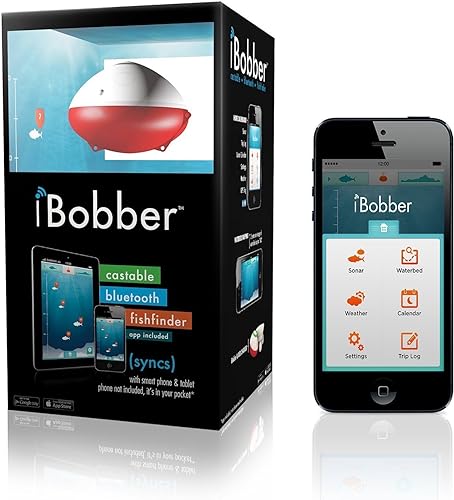
ReelSonar iBobber: Best for casting from a canoe seat
- 135 ft depth range
- 10+ hours battery life
- Bluetooth to iOS and Android app
- Fish and strike alarms
A castable sonar unit that pairs to your phone, so the canoe needs no bracket, cable or drilling. The depth-tagged fish icons and alarms help when your hands are busy with a paddle.
Pros
- Cast or troll it without mounting hardware
- 10+ hours per charge
- Fish and strike alarms
- Fits in a tackle box or pocket
Cons
- Reads through a phone app, so keep the battery up
- 135 ft depth limit is the lowest here
The iBobber suits a paddler who wants to read the water without adding a single bracket to the canoe. You cast it on your line or lower it over the side, and it sends sonar to your phone over Bluetooth from up to 100 ft away.
Its 135 ft depth range covers the lakes and rivers most canoe trips see. Depth-tagged fish icons come color coded by size, so you know whether the marks under the boat are bait or something worth casting at.
The fish alarm and strike alert free your eyes from the screen when a school moves under the hull.
The rechargeable battery runs 10+ hours, enough for a long paddle day. The app lets you map waterbeds, mark spots and log water temperature, depth, lures and species in a trip log.
It measures just 2 x 2 x 1 inches and weighs next to nothing, so it lives in a pocket or tackle box. A 1-year warranty backs it.
Trade-offs: it reads through a phone app, so keep that phone charged. Its depth limit is also the lowest in this group, so deep trolling is not its job.
For a hull-mounted alternative, see our guide to the portable fish finder for kayak setups.
Humminbird Helix 5 CHIRP GPS G3: Best for mapping new water
- Dual Spectrum CHIRP sonar
- Humminbird Basemap with 10,000+ lakes
- AutoChart Live depth mapping
- 5-inch color display
A full chartplotter with sonar, GPS and live mapping in one unit. It suits a canoe that carries a battery and a transducer, not a bare hull.
Pros
- Built-in GPS and basemap charts
- AutoChart Live builds maps as you paddle
- CHIRP sonar with wide and narrow modes
Cons
- Corded power needs a 12V battery
- Transom mount means extra rigging
- Heaviest pick here at 2.1 lb
The Helix 5 is the pick when the canoe sees big, unfamiliar water and you want to build a map as you go. Humminbird's basemap covers 10,000+ lakes and the continental U.S. coastlines, and AutoChart Live records depth contours, bottom hardness and vegetation with eight hours of built-in recording.
Dual Spectrum CHIRP gives you a wide mode for coverage and a narrow mode for detail. A Low-Q transducer sharpens 2D target separation, so fish arches read clearly against structure.
The 5-inch color TFT and keypad controls work in wet weather, which matters when spray comes over the gunwale.
This is a mounted unit: the transom transducer and corded power mean a 12V battery aboard and some rigging before launch. It weighs 2.1 lb and costs more than the castable picks.
It can also accept premium LakeMaster, CoastMaster and Navionics charts if you want more detail later.
Choose it if mapping and GPS matter more than portability. For lighter setups, read how to make a fish finder portable.
LUCKY Portable Handheld Fish Finder: Best for reading depth without a phone
- 2.4-inch color LCD
- 328 ft depth detection
- 26 ft wired transducer
- About 5 hours per charge
A handheld display with its own screen and a wired transducer you toss over the side. No phone, no app and no Bluetooth pairing to fuss with mid-paddle.
Pros
- Own color screen, no app needed
- Rechargeable over USB
- Depth, temperature and fish size on one screen
- Transducer bracket can clamp to a canoe
Cons
- 26 ft cable needs managing in a small canoe
- About 5 hours per charge
- Screen is small for bright sun
The LUCKY Portable Handheld suits a canoe angler who leaves the phone in a dry bag. Its 2.4-inch color LCD shows depth, water temperature, fish size and fish depth without any app or pairing step.
A simulation mode lets you learn the buttons before you float.
A 45-degree beam at 200 kHz detects down to 328 ft, and the rechargeable battery runs about 5 hours over USB. The 26 ft wired transducer reaches over the side from a seated position and gives you 26 ft of operating distance from the display.
Its transducer bracket can attach to the canoe, so the sensor stays put while the display sits in your lap. You can set sensitivity, screen brightness, depth range, zoom, depth alarm, fish alarm, fish icon and units yourself.
The 2.4-inch screen can wash out in direct sun, so angle it away from glare.
The 26 ft cable needs stowing in a small hull, and 5 hours means charging between trips. Pick it if a dedicated screen matters; pick the iBobber if you'd rather cast free of wires.
Deeper PRO+ 2: Best for deep lakes and GPS maps
- 330 ft depth range
- Built-in GPS
- Wide, mid and narrow beams
- Wi-Fi connection to the Fish Deeper app
The most capable castable unit here, with three beam widths, GPS and shoreline bathymetric mapping. Best when the canoe sees big, deep water.
Pros
- 330 ft depth range
- Three beam widths for coverage or detail
- GPS maps built from shore or boat
- Weighs 3.2 oz
Cons
- Needs a charged phone for the app
- Premium price tier
The Deeper PRO+ 2 is the strongest castable unit here for deep water and mapping. Its three beams (wide, mid and narrow) let you cover water fast or drill into a specific spot, and the 330 ft depth range goes well past most canoe water.
Built-in GPS lets you build bathymetric maps from the shore, dock or bank, and every map saves to the Fish Deeper app. Target separation of 0.4 in on the narrow beam tracks small lures when you jig vertically, while the wide and mid beams hold 1 in separation.
Its own Wi-Fi keeps connectivity solid without leaning on mobile data.
It weighs 3.2 oz and rides on Wi-Fi from the phone, so there's no cable and no mount. The phone becomes your display and your map store, so its battery is the real limit.
A 2-year limited warranty covers the unit.
This is the premium pick. Choose it for deep reservoirs; choose the Deeper Start for shallow floats and shorter days.
See the portable fish finder for small boat picks for larger hulls.
Yoocylii Handheld Fish Finder: Best for a neck strap and simple reads
- 200 kHz sonar with 45-degree beam
- 328 ft depth range
- 4 AAA batteries
- Neck strap and transducer float
A basic handheld unit that hangs around your neck and runs on common batteries. The simplest setup in this group for a paddler who wants depth and fish marks only.
Pros
- Neck strap keeps it within reach
- Standard AAA batteries
- Shows bottom type and fish size
- Works in fresh and salt water
Cons
- 4-5 hours per set of batteries
- Basic display compared with the Helix
- 25 ft transducer cable to stow
The Yoocylii is the simplest unit to live with on a paddle. A neck strap keeps the display at chest height, and the transducer float plus a 25 ft cable means you toss the sensor and read as you drift.
It also ships with a side-scan adapter and mounting bolt if you want to clamp it on.
It runs on 4 AAA batteries for 4-5 hours and reads depth from 3 to 328 ft with a 200 kHz, 45-degree beam. The screen shows fish size and depth plus bottom type (grass, rock, sand) and works in fresh and salt water.
It tolerates water from 14°F to 113°F.
Setup is toss-and-turn-on, and settings for sensitivity, backlight and fish alarm save when you power it down. Five sensitivity levels and a battery save mode stretch the AAAs.
That makes it easy to hand off to a friend or stow in a tackle box.
The trade-off is the battery habit and the basic screen. If you want rechargeable and color, the LUCKY Handheld is a step up.
Pick the Yoocylii for low-fuss depth and fish marks.
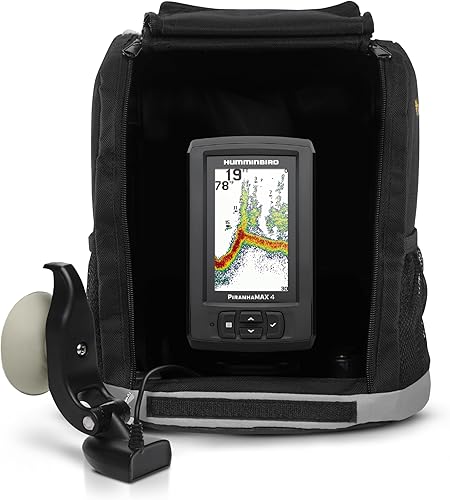
Humminbird PiranhaMAX 4 Portable: Best for a self-contained canoe kit
- Dual Beam sonar
- 4.3-inch color LCD
- Soft-sided carrying case
- 7 Ah battery and charger included
A complete portable kit with display, case, transducer and its own battery. It arrives ready to strap into a canoe without buying power gear separately.
Pros
- Battery and charger in the box
- Carrying case protects the display
- Dual Beam sonar with wide and narrow settings
- Tilt and swivel mount
Cons
- Bulkier than a castable unit
- 7 Ah battery adds weight to a portage
- Older sonar than the Helix
The PiranhaMAX 4 Portable is the ready-made kit: display, soft-sided carrying case, portable transducer, 7 Ah battery and wall charger all in one box. You charge it at home and carry it to the launch with no separate power purchase.
Its 4.3-inch color LCD and Dual Beam sonar let you switch between a wide beam for coverage and a narrow beam for detail. Fish ID+ reads fish as icons with depth, and fish alarms, depth alarms and zoom are all one button away.
The tilt and swivel mount lets you aim the screen from a seated paddling position.
Humminbird backs it with a 1-year limited warranty. It suits a family canoe or a shared camp boat that stays rigged at the water.
The soft case also protects the display in the back of a truck or a canoe hold.
Trade-offs: the case and 7 Ah battery add bulk and weight on a portage, and the sonar is older than the Helix 5's. If you need to carry the canoe on your shoulders, a castable unit is lighter.
For mounting tips, read how to mount a fish finder on a kayak.
Lowrance Eagle 4x: Best for bright sun and small spaces
- 4-inch IPS portrait screen
- Auto-Tuning sonar
- 200 kHz Bullet Skimmer transducer
- Twist-lock connector
A compact sonar display with the brightest screen here and automatic sonar settings. The twist-lock cable makes setup and teardown at the launch quick.
Pros
- IPS screen reads through polarized sunglasses
- Auto-Tuning sonar reduces dialing
- 500 ft depth range
- Removable display via twist-lock connector
Cons
- Needs a separate 12V battery
- Narrow 44-degree beam
- No fish alarm
The Lowrance Eagle 4x is the pick for bright sun and tight cockpit space. Its 4-inch IPS portrait screen stays clear in direct sunlight and through polarized sunglasses, and the portrait shape takes less width on a thwart or seat back.
Auto-Tuning sonar picks the settings for you, so there's less fiddling and more paddling. The included 200 kHz Bullet Skimmer gives a broad 44-degree beam, and depth detection reaches 500 ft.
Fish icons show depth and zoom gives a closer look without an audible fish alarm.
The twist-lock connector makes the display easy to pull off in the end. Mounting options cover surface, panel and flush mount, so it can sit on a seat bracket or drop into a cutout on a larger canoe.
The compact body measures 7 x 4 x 3.84 inches.
It's a mounted unit though, so it needs a separate 12V battery and a transducer mount. Its narrow beam and lack of a fish alarm make it less friendly for spotting schools than the castable picks.
Choose it for sun-proof reading and wide depth. Our paddle craft sonar category covers the mounting options.
Deeper Start: Best for shore stops and short trips
- 165 ft cast and depth range
- 40-degree sonar beam
- Wi-Fi to the Fish Deeper app
- 6 hours battery life
An easy castable sonar for a casual canoe float, with a phone app and no wires. The depth limit and short battery life suit short days and shallow water.
Pros
- Simple cast-and-read setup
- Full charge in about 2.5 hours
- Night fishing mode
- Saves scans with time and location
Cons
- 165 ft depth limit
- 6 hours of battery
- No GPS mapping like the PRO+ 2
The Deeper Start is the easy entry into castable sonar. You tie it on, cast, and pair with the Fish Deeper app for fish location and size, depth, bottom contour and vegetation.
It weighs 0.07 kg and casts as far as 165 ft.
Its 40-degree beam reads to 165 ft, and a full charge takes about 2.5 hours for 6 hours of use. It generates its own Wi-Fi, so it won't use mobile data, and it saves every scan with time and location for easy revisits.
A night fishing mode helps for evening floats. It suits shore stops and short trips where you want a quick read without a mounted setup.
The app works on iOS and Android and downloads free.
The trade-offs are the depth limit and the 6-hour battery, both short of the iBobber and PRO+ 2. For longer days or deeper lakes, step up.
Pick the Start for casual paddles and bank stops.
LUCKY Kayak Wireless Fish Finder: Best for long casts without a phone
- 853 ft wireless range
- 3.5-inch horizontal LCD
- 3-147 ft depth range
- 90-degree beam
A wireless castable unit with its own wide screen, so the sonar floats while you read the display in your hand. Suits canoe anglers who skip the phone.
Pros
- Own 3.5-inch screen, no app
- 853 ft wireless range
- 90-degree beam covers wide water
- Cast or tether the floating sensor
Cons
- 147 ft depth limit
- No GPS or mapping
- Needs charging the display and sensor
The LUCKY Kayak Wireless Fish Finder suits an angler who wants a wide screen without the phone. Its 3.5-inch horizontal LCD shows fish icons with exact depth numbers and scrolls right to left so you can track movement and spot structure you've already passed.
The floating sensor connects wirelessly from up to 853 ft, among the longest ranges here. A 90-degree beam scans 3-147 ft deep, and the display plus sensor together weigh less than a 1-liter water bottle.
The tether means a dropped cast comes back.
Setup is cast and read, with no drilling or brackets. It works across shore, kayak, canoe and ice fishing.
You tie the sensor to your line or the included safety tether and cast it like a bobber over weed beds, structure or deep channels.
Its limits are the 147 ft depth range and the lack of GPS or mapping. It's the lowest-scoring pick here, so choose it only if a dedicated wide screen at long range matters more than depth capability.
Otherwise the LUCKY Handheld or iBobber gives more for the money.
How these portable fish finders compare
Castable units win on weight and setup, while mounted units win on screen size, depth and mapping. The table below lines up the picks on mounting, depth and power so you can match one to your canoe.
| Product | Best for | Mounting | Max depth | Power | Our score |
|---|---|---|---|---|---|
| ReelSonar iBobber | casting from a canoe seat | Fishing line | 135 ft | Rechargeable battery | 9.1 |
| Humminbird Helix 5 CHIRP GPS G3 | mapping new water | Transom | Corded electric | 8.8 | |
| LUCKY Portable Handheld Fish Finder | reading depth without a phone | Surface mount | 328 ft | 8.6 | |
| Deeper PRO+ 2 | deep lakes and GPS maps | Surface or cast | 330 ft | Rechargeable battery | 8.5 |
| Yoocylii Handheld Fish Finder | a neck strap and simple reads | Surface mount | 328 ft | 4 AAA batteries | 8.2 |
| Humminbird PiranhaMAX 4 Portable | a self-contained canoe kit | Surface mount | 7 Ah battery | 7.7 | |
| Lowrance Eagle 4x | bright sun and small spaces | Surface, panel or flush mount | 500 ft | 7.6 | |
| Deeper Start | shore stops and short trips | Handheld or cast | 165 ft | Rechargeable battery | 7.2 |
| LUCKY Kayak Wireless Fish Finder | long casts without a phone | Portable and castable | 147 ft | 6.8 |
Castable units versus mounted units at a glance
The castable group (iBobber, Deeper PRO+ 2, Deeper Start, LUCKY Kayak Wireless) needs nothing bolted to the canoe. You tie the sonar to a line or tether, toss it over the side and read on a phone or a dedicated display.
Depth ranges run from 135 ft to 330 ft, and battery life from 6 to 10+ hours.
The mounted group (Helix 5, LUCKY Portable Handheld, Yoocylii, PiranhaMAX 4, Eagle 4x) puts a screen on a bracket and a transducer in the water. These reach 135 ft to 500 ft and offer bigger screens, brighter panels and, in the Helix's case, GPS mapping.
They cost more in rigging time and, for the corded units, in battery weight.
How we compared these canoe fish finders
We started from the specs that decide a canoe setup: weight, mounting type, depth range, battery life and whether the unit needs a phone. Every pick here runs on its own battery or a portable one, so none needs wiring into a canoe's hull.
Castable units scored higher when they cast without a mount, ran 10+ hours and kept a usable screen. Mounted units earned points for depth reach, mapping and glare resistance, and lost points for battery weight and rigging time.
We also weighed the display choice. A dedicated screen keeps your phone dry and your eyes off a small app, while an app adds mapping and saves gear weight.
The badge on each card names the buyer it fits best.
What should a canoe angler look for in a portable fish finder?
A canoe angler should put portability first: weight under about 1 lb, a battery that lasts the paddle day and a mount that needs no holes. Depth range and screen type come next, based on the water you fish.
Castable or mounted: which fits a canoe?
A castable unit fits most canoes because it needs no bracket, cable or hull hole. A mounted unit fits when the canoe stays rigged at the water and you can carry a 12V battery.
Castable units like the iBobber and Deeper models tie to your line and float on the surface. Mounted displays like the Helix 5 and Eagle 4x need a bracket and a power source, which is more gear in a small hull.
If you paddle different waters every trip, the castable path saves setup time at every launch.
How much depth range do you need?
Most canoe water is shallow enough that a 135 ft unit covers it. Pick a 328 ft or 500 ft unit only for deep reservoirs and trolling.
The iBobber reaches 135 ft and the Deeper Start 165 ft. The LUCKY Handheld and Yoocylii go to 328 ft, while the Eagle 4x reaches 500 ft.
Match the range to your deepest planned lake, not the deepest number on the page. A wide depth claim costs nothing extra on paper, but it often comes with a bigger, heavier unit.
Is a phone app screen good enough?
A phone app screen is good enough for most paddlers and saves weight and bulk. Pick a dedicated display if you want your phone in a dry bag or read in bright sun.
The iBobber and both Deeper units pair to iOS or Android. The LUCKY Handheld, Yoocylii, PiranhaMAX 4, Helix 5 and Eagle 4x each have their own screen.
The Eagle's IPS screen handles glare best. If you paddle alone and use the phone for maps and safety, an app unit keeps your gear count down.
How do you power a fish finder on a canoe?
Power a castable unit by charging it at home, and a mounted unit with a small 12V battery. Castable units are the easiest because the battery is sealed inside the sonar body.
The iBobber runs 10+ hours per charge, the Deeper Start about 6 hours and the PRO+ 2 longer. The LUCKY Handheld gives about 5 hours.
The PiranhaMAX kit includes a 7 Ah battery and charger. Plan your charge around the trip, not the box claim.
A spare USB power bank for the phone or handheld display is cheap insurance on a long day.
What about mounting and storage on a short hull?
Keep the unit light and stowable, and use a clamp or strap rather than screws. A canoe has less flat surface than a boat, so a castable unit or a clamp-on bracket works best.
The iBobber and Yoocylii fit in a tackle box. The PiranhaMAX case protects the display in transit.
If you do mount a display, a removable twist-lock like the Eagle's makes teardown quick. And remember to tie the castable sonar to a tether before the first throw.
What sonar features help most on a canoe?
Fish alarms, depth alarms and zoom help most when your hands are busy with a paddle. Fish alarms free your eyes from the screen, depth alarms keep you off shoals, and zoom lets you inspect a small patch of bottom without a bigger display.
The iBobber adds a strike alert for when fish are biting. The LUCKY Handheld, Yoocylii and PiranhaMAX 4 each offer fish and depth alarms.
The Eagle 4x drops the audible fish alarm, so it rewards a glance rather than an ear. Beam width matters too: a 90-degree beam like the LUCKY Kayak Wireless covers wide water, while a 40 to 45-degree beam concentrates on a smaller patch.
The verdict on the best portable fish finder for canoe
The ReelSonar iBobber is the best portable fish finder for canoe trips for most paddlers, thanks to its cast-from-anywhere sonar, 10+ hours of battery and no-mount design. Pick the Deeper PRO+ 2 if you fish deep water and want GPS maps, or the Humminbird Helix 5 if you'd rather have a mounted chartplotter.
For a screen without a phone, the LUCKY Portable Handheld is the clear step up from the Yoocylii. For sun glare and small spaces, the Lowrance Eagle 4x is the display to beat.
Skip the LUCKY Kayak Wireless unless a wide dedicated screen at long range is your top priority.
Whichever you choose, keep the charge topped up and tie the sonar to a tether. A light kit and a charged battery turn a quiet paddle into a scouting trip.
Our top 3 picks at a glance
-
1
-
2
-
3
Best for reading depth without a phone
LUCKY Portable Handheld Fish Finder
8.6/10 our score
See it on Amazon
Frequently asked questions
Do I need to drill a canoe to use a fish finder?
No. A castable unit like the iBobber or a Deeper needs no holes at all, and a clamp-on bracket holds most portable displays without drilling.
Reserve screws and bolts for a canoe you plan to keep rigged.
How do castable fish finders stay attached in a canoe?
You tie the unit to your fishing line or a safety tether and cast or lower it over the side. The floating body rides on the surface and sends sonar down from there, so a lost grip costs you a retrieve rather than the device.
What depth range matters for canoe fishing?
Most canoe water is shallow, so even a 135 ft unit covers the lakes and rivers you paddle. A 328 ft or 500 ft unit matters on deep reservoirs or trolling big water, where knowing the bottom matters more than covering distance.
Can I run a fish finder all day on a canoe?
A castable unit with 10+ hours of battery covers a full paddle day, and the Deeper Start gives about 6 hours. Displays running on their own 12V battery last longer but add weight, so plan the trip around the charge you carry.
Will a fish finder work from a moving canoe?
Yes, at paddling speed. A transducer needs to sit level in the water and the hull should move slowly, under about 5 mph, for steady readings.
Stop paddling and let the canoe drift for the cleanest picture of fish and bottom.