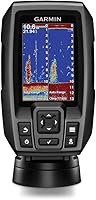
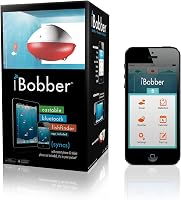
9 Best Fish Finders That Work With a Phone (November 2026)
The best phone-connected fish finders include the ReelSonar iBobber for most anglers, the Deeper PRO+ 2 for mapping new water, and the Deeper Start for bank and dock fishing.
On this page (4 sections)
The best fish finder for your phone is the ReelSonar iBobber, because it casts on a fishing line, pairs over Bluetooth and shows depth, bottom contour and fish marks in a free app. Choose the Deeper PRO+ 2 if you want to map a lake, the Humminbird Helix 5 if you would rather have a built-in screen with GPS, or the LUCKY handheld for the lowest cost.
A phone fish finder works by turning your mobile screen into the display. The unit you cast or tie to the boat sends sonar or camera data back to an app.
That keeps the gear small and removes the need for a mounted screen.
The trade-off is battery and signal. Your phone has to stay charged and within range of the unit.
For open-water boat work, a standalone unit still wins. This guide covers both paths so you can match the gear to how you fish.
Our picks at a glance
-
1
-
2

-
3

- 4
 Check it
Humminbird Helix 5 CHIRP GPS G3
Best for boat navigation - 5
 Check it
TMACTIME 1080P Underwater Camera
Best for seeing fish bite - 6
 Best for small boats and kayaksCheck it
- 7
 Check it
LUCKY Portable Handheld Fish Finder
Best budget handheld - 8
 Check it
LUCKY Kayak Wireless Fish Finder
Best for long casts from shore - 9
 Check it
Takkicept Underwater Fishing Finder Camera
Best for murky water viewing
Best fish finders for your phone compared
The iBobber takes the top spot for most anglers, and every other pick earns its place for a named need. The Deeper PRO+ 2 is the mapping choice.
The Humminbird and LUCKY units are the screen-based options when you don't want to depend on a phone.
Our score weighs specs, features and buyer feedback against what you're shopping for. Depth range, app quality and how you carry the unit count most.
The app side matters more than the hardware for the phone-linked units. A castable sonar is only as good as the screen that shows its data, so we looked at whether the app marks fish by size and depth, logs the water temperature and saves spots for a return trip.
Those features separate a useful phone finder from a gadget that only blinks a depth number.
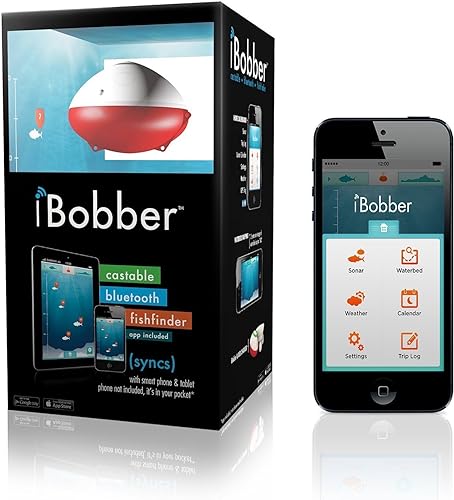
ReelSonar iBobber: Best for most anglers
- Castable Bluetooth sonar
- 135 ft depth range
- 10+ hours battery life
- Fish and strike alarms
A pocket-sized sonar you cast on a line and read on your phone. The app maps bottom contours and marks fish by size and depth.
Pros
- Fits in a pocket or tackle box
- Syncs up to 100 ft from the phone
- Trip log records spots and water temps
Cons
- Needs a charged phone to see anything
- Sonar only, no camera view
The iBobber suits the angler who fishes from a kayak, a canoe or the bank and wants sonar without mounting anything. You tie it to your line, cast it like a bobber and watch the picture appear on your phone.
Its 135 ft depth range covers most lakes and rivers. The app syncs over Bluetooth up to 100 ft away and saves each scan with a trip log for spots, water temperature and depth.
A fish alarm tells you when fish gather under docks and piers.
The LED beacon and strike alert help at night or through the ice. The small body makes it easy to carry in a pocket.
The catch is that you need a charged phone and the app open, and the iBobber shows sonar only, not a camera view. It's the simplest way to put a fish finder for your phone in your tackle box.
Deeper PRO+ 2: Best for mapping new water
- Built-in GPS for bathymetric maps
- Depth to 330 ft
- Wide, mid and narrow beams
- Target separation of 0.4 in
A castable sonar with its own Wi-Fi and GPS. It builds lake maps as you retrieve it and saves them in the Fish Deeper app.
Pros
- Maps saved to the app
- Three beam widths
- Own Wi-Fi keeps mobile data free
Cons
- Premium price tier
- Map detail depends on your casting coverage
Deeper's PRO+ 2 is for the angler who wants to build a map of unfamiliar water. Its built-in GPS records bathymetric maps from the shore, dock or bank, and every map saves to the Fish Deeper app.
Three beam widths let you cover large areas or drill into a single spot. The maker claims target separation down to 0.4 in on the narrow beam, so even small lures can show up when you jig vertically.
Depth reaches 330 ft, well beyond the iBobber.
It runs on its own Wi-Fi rather than Bluetooth, so the signal stays steady at distance. The main trade-off is price tier: this is the most expensive sonar-only unit in the group.
It also rewards you only if you use the mapping. For casual depth checks on a small pond, the iBobber costs less and does the core job.
Humminbird Helix 5 CHIRP GPS G3: Best for boat navigation
- Dual Spectrum CHIRP sonar
- Humminbird Basemap with 10,000+ lakes
- AutoChart Live mapping
- 5-inch color display
A full chartplotter with sonar that puts mapping on its own screen. It works without a phone and adds live contour mapping while you boat.
Pros
- Built-in Basemap coverage
- AutoChart Live creates maps in real time
- Buttons work in wet weather
Cons
- Not phone-driven; it carries its own display
- Wired power and transducer install
The Helix 5 is the pick for anyone who wants sonar and navigation without pairing a phone. It's a full chartplotter with a 5-inch color display and Humminbird Basemap covering more than 10,000 lakes and the continental U.S. coastlines.
Dual Spectrum CHIRP sonar gives you a wide mode for coverage and a narrow mode for detail. The low-Q transducer sharpens 2D target separation, so separate fish and structure read as distinct marks rather than one blur.
AutoChart Live creates depth-contour maps in real time while you boat, with eight hours of built-in recording. The keypad works in wet weather.
The trade-off is installation and setup. It needs wired power and a transom-mounted transducer, so it suits boats more than kayaks.
It's not a phone fish finder in the app sense, but it's the honest alternative when a phone screen in sunlight and spray isn't practical. LakeMaster and Navionics cards add premium charts if the built-in Basemap runs out on your home water.
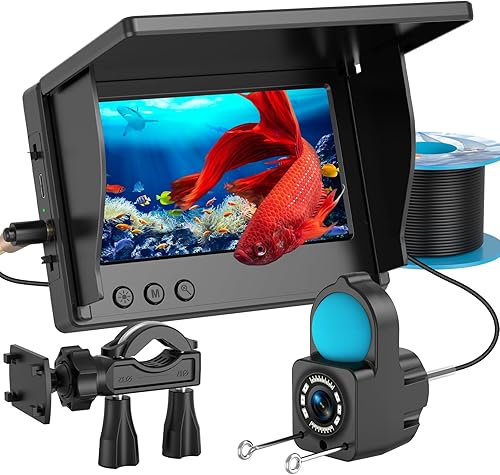
TMACTIME 1080P Underwater Camera: Best for seeing fish bite
- 1080P HD lens
- 4.3-inch LCD screen
- 6 IR night-vision lights
- 15 m cable, IP68
A real-time underwater camera for ice, boat and kayak fishing. The IR lights keep the picture usable in dark or murky water.
Pros
- Clear HD picture on the supplied screen
- Up to 10 hours on the 5000mAh battery
- IP68 cable rated to 15 m
Cons
- Real-time viewing only, no recording
- Not a phone app; the display is the screen
TMACTIME's underwater camera gives you eyes under the ice or boat instead of a sonar mark. The 1080P lens feeds a 4.3-inch LCD, and six IR lights keep the picture clear in dark or murky conditions.
The IP68 cable handles depths to 15 m with a 100 kg load rating. A 5000mAh battery runs up to 10 hours, so a full day on the ice or a long boat trip is covered.
It's plug and play, with no setup beyond plugging in the cable. The kit includes the monitor, the camera on its cable, a stand and a charging cable.
The big trade-off is reach and storage. The camera views in real time only and doesn't record, and 15 m is shallower than the Deeper units.
Choose it when watching a bait or jig actually get hit matters more than scanning a wide area. It also works well as a scouting tool at the start of a session, checking weed edges or a drop-off before you commit a lure.
Lowrance Eagle 4x: Best for small boats and kayaks
- 4-inch IPS portrait screen
- Auto-Tuning Sonar
- 200 kHz Bullet Skimmer
- Depth to 500 ft
A compact sonar head with a bright screen and automatic tuning. The 44-degree beam suits kayaks and small boats in shallow water.
Pros
- Readable through polarized sunglasses
- Fast twist-lock connector
- Wide 44-degree beam
Cons
- No phone app
- No audible fish alarm
The Lowrance Eagle 4x suits kayaks and small boats where space is tight. Its 4-inch IPS portrait screen stays readable from wide angles and through polarized sunglasses.
Auto-Tuning Sonar sets the sensitivity and range for you, so there's less fiddling at the ramp. The included 200 kHz Bullet Skimmer spreads a 44-degree beam, which covers a wide patch under a kayak in shallow water.
Depth goes to 500 ft. Fish icons carry depth labels, and a zoom gives you a closer look without an audible alarm.
The twist-lock connector makes removing the display quick for travel or storage. It has no phone app and no audible fish alarm, so it's a screen-first unit.
It earns its place here as the budget chartplotter option for a paddle craft that already has a transducer mount. The portrait shape uses less room on a narrow kayak deck than a wide landscape screen.
LUCKY Portable Handheld Fish Finder: Best budget handheld
- 2.4-inch color LCD
- 328 ft depth detection
- 26 ft wired transducer
- About 5 hours per charge
A wired handheld unit that shows depth, temperature and fish size on its own screen. The bracket attaches the transducer to a boat or kayak.
Pros
- Works without a phone
- Simulation mode to practice settings
- Low price tier
Cons
- 26 ft cable limits casting reach
- Short 5-hour battery life
The LUCKY handheld is the low-cost way to get sonar depth and fish marks without a phone. Its 2.4-inch color screen shows underwater contour, water temperature, fish size and fish depth.
A 26 ft wired transducer reaches 328 ft of depth with a 45-degree beam at 200 kHz. The bracket attaches the transducer to a boat or kayak, and a simulation mode lets you practice with every setting before you fish.
Sensitivity, brightness, depth range and alarms are all adjustable. Three contour display styles let you pick the readout that suits your water.
The limits are the cable and the battery. A 26 ft wired reach means no long casts, so this is a boat or kayak unit rather than a bank tool.
About 5 hours per charge is shorter than the iBobber or Deeper units. For a first fish finder at a low price, it still does the job.
It also reads water temperature, which the castable units leave to the app.
LUCKY Kayak Wireless Fish Finder: Best for long casts from shore
- 853 ft wireless range
- 3.5-inch horizontal LCD
- 90 degree beam
- 147 ft depth area
A castable sensor with a separate handheld display. The long wireless range lets you read the sonar far from the sensor.
Pros
- Longest wireless range here
- Separate display, no phone needed
- Floating sensor
Cons
- Own screen instead of a phone app
- Shallower depth than the Deeper units
LUCKY's wireless model sends sonar from a floating sensor to a separate 3.5-inch handheld display. Its 853 ft wireless range is the longest in this group, so you can cast the sensor well out and still read the screen.
The 90-degree beam scans a 3 ft to 147 ft depth area and shows fish icons with their exact depth. The horizontal display scrolls right to left, so you see a history of what the sensor passed over.
The whole set weighs less than a 1-liter bottle. You tie the sensor to your line or the included safety tether and cast it like a bobber, with no drilling or brackets.
It's not a phone app unit; the display is its own screen. Its 147 ft depth is also shallower than the Deeper and LUCKY handheld units.
Choose it when long casting distance from shore or a dock matters most and you don't want to use your phone. It handles a summer lake and an ice hole without a change, which suits anglers who switch seasons more than they switch gear.
Takkicept Underwater Fishing Finder Camera: Best for murky water viewing
- 220 degree wide-angle lens
- 5-inch IPS screen at 1500 nits
- 8 IR night-vision LEDs
- 8000mAh battery, IP68
A wide-angle underwater camera with a bright screen and a sunshade. It's built for seeing structure and fish movement in dim or cloudy water.
Pros
- Very wide 220 degree view
- Sunshade for daylight viewing
- Up to 15 hours per charge
Cons
- Bulky next to the castable sonar units
- Screen-based, not phone-based
Takkicept's camera is built for seeing into cloudy water. A 220-degree wide-angle lens and a 5-inch IPS screen at 1500 nits, with a foldable sunshade, keep the view usable in direct sun or murk.
Eight IR LEDs handle night vision, and the IP68 camera sits on a 30 m cable with 170 lb tensile strength. An 8000mAh battery runs up to 15 hours.
The kit includes a storage bag, stand and adapter. Backlight and chroma settings let you tune the picture for turbid water, and the screen's wide viewing angle means a second angler can watch over your shoulder.
The size is the trade-off. It's a bulkier kit than the pocket-sized castable sonar units, so it suits a boat bag or ice shelter more than a wader pocket.
It's also screen-based and not phone-linked. Pick it when a wide, bright underwater view is the whole point.
The 220-degree lens shows more of the scene per look than the narrower cameras here.
Deeper Start: Best for bank and dock fishing
- Castable to 165 ft
- Depth to 165 ft
- 40 degree sonar beam
- 6 hours battery life
The simple entry to phone sonar: cast it, pair the Fish Deeper app and read fish location, depth and bottom contour.
Pros
- Fast setup
- Full charge in 2.5 hours
- Night fishing mode
Cons
- No built-in GPS mapping
- Single beam width
Deeper Start is the low-cost entry to castable phone sonar. You pair it with the free Fish Deeper app and see fish location and size, depth, bottom contour and vegetation.
It casts to 165 ft and reads to 165 ft with a 40-degree beam. The maker claims a 2.5-hour full charge and about 6 hours of battery.
A night fishing mode helps after dark. It makes its own Wi-Fi, so it won't use your mobile data.
Every scan saves with time and location, so you can return to a spot that produced fish.
The trade-off against the PRO+ 2 is mapping. Start saves each scan with time and location for revisits, but it doesn't build full bathymetric maps.
It's also a single beam. For a casual angler on a dock or bank who wants the basic phone sonar picture, it's the cheaper way in.
It's the sensible first phone sonar for a family trip or a beginner who wants to learn how sonar reads before spending on mapping features.
How these phone fish finders were compared
We started with what "phone fish finder" actually means. Some units send data to a phone app.
Others carry their own screen. Both are in this list, and each card says which one it is.
Then we checked the numbers that change daily use: maximum depth, wireless range, battery life and beam width. A longer depth range helps on deep lakes.
A wider beam covers more ground per cast. A longer battery keeps the app fed all day.
Beam width deserves its own note. A narrow beam like the Deeper's 0.4 in target separation resolves small lures and tight structure.
A wide beam like the Lowrance 44-degree or the Takkicept 220-degree lens covers more water per pass. Neither is better in the abstract.
The right beam depends on whether you are searching a flat or picking apart a single brush pile.
App features counted too. The iBobber and Deeper units log trips, mark spots and save scans.
That's the real benefit of putting the display on your phone.
We ranked the rest by fit for common fishing styles: bank and dock, kayak, ice, and open-water boat. A unit that's great on a boat may be awkward in a wader pocket.
Our score weighs specs, features and buyer feedback against what you're shopping for.
| Product | Best for | Display | Max depth | Mount | Our score |
|---|---|---|---|---|---|
| ReelSonar iBobber | most anglers | Phone app | 135 ft | Fishing line | 9.1 |
| Deeper PRO+ 2 | mapping new water | Phone app | 330 ft | Castable | 8.5 |
| Deeper Start | bank and dock fishing | Phone app | 165 ft | Handheld | 7.2 |
| Humminbird Helix 5 CHIRP GPS G3 | boat navigation | 5 in color TFT | Transom | 8.8 | |
| TMACTIME 1080P Underwater Camera | seeing fish bite | 4.3 in LCD | 15 m | 9.4 | |
| Lowrance Eagle 4x | small boats and kayaks | 4 in IPS | 500 ft | Surface, panel or flush | 7.6 |
| LUCKY Portable Handheld Fish Finder | budget handheld | 2.4 in color LCD | 328 ft | Surface | 8.6 |
| LUCKY Kayak Wireless Fish Finder | long casts from shore | 3.5 in LCD | 147 ft | Castable | 6.8 |
| Takkicept Underwater Fishing Finder Camera | murky water viewing | 5 in IPS | 30 m | 7.8 |
Which fish finder for your phone suits your fishing?
The right unit comes down to how you fish and whether you want the app to be the screen. Answer these first, then pick.
Do you need a phone app or a built-in screen?
A castable unit like the iBobber or Deeper sends the picture to your phone. That keeps the gear small and light.
A screen-based unit like the Humminbird, Lowrance or LUCKY models carries its own display. That's better when your phone battery is a worry or you fish in bright sun and spray.
If you want to share the view or review the trip later, the app route wins. If you want gear that works on its own, pick the screen.
Our guide to whether fish finders work and what they show covers what each type can and can't display.
A middle path exists too. The LUCKY wireless set and the castable Deeper units both let you fish without mounting a transducer on the hull, but only the LUCKY set shows the picture on a dedicated screen.
Decide whether the phone is a help or a burden before you pick.
How deep do you fish?
Depth range is the first spec to match. The iBobber reads to 135 ft.
The LUCKY handheld goes to 328 ft and the Deeper PRO+ 2 to 330 ft. Underwater cameras sit much shallower, around 15 to 30 m.
If you fish deep reservoirs or troll over drop-offs, pick one of the longer-range units. For ponds, shallow bays and dock edges, the iBobber or a camera covers it.
A 135 ft limit sounds generous until you fish a steep-sided reservoir, where the bottom can drop past that within a cast of the bank.
Castable or mounted?
A castable unit is the best fit for bank and dock fishing. You tie it to your line, cast it out and read the app.
Our fish finder for shore fishing guide compares the casting options.
A mounted unit suits a kayak or boat where you can fix the transducer. The LUCKY handheld and the Humminbird use brackets or a transom mount.
On a kayak, see how to mount a fish finder on a kayak before you buy the unit.
How long does the battery last?
Battery life decides how much you can scan in a trip. The iBobber runs more than 10 hours.
The Deeper Start manages about 6 hours. The LUCKY handheld gives about 5 hours.
The cameras run 10 to 15 hours.
Plan for the unit and the phone. A long sonar session drains your mobile battery too, so carry a power bank on full days.
A screen-based unit takes your phone out of the equation.
What do you carry it in?
Size matters more than specs once you're on the water. The iBobber is pocket-sized.
The LUCKY wireless set weighs less than a 1-liter bottle. The cameras come as kits with a monitor and cable, so they suit a boat bag or ice shelter.
If portability is the priority, look at our best portable fish finders for kayaks roundup. It lists the lightest units for a paddle craft.
The verdict on fish finders for your phone
Pick the ReelSonar iBobber if you want the best all-round fish finder for your phone. It's the easiest to carry, casts from a line and covers 135 ft, all in a free app.
Pick the Deeper PRO+ 2 when mapping new water is the goal. Its built-in GPS and three beams earn the higher cost for serious anglers.
Pick the Humminbird Helix 5 if you would rather have a chartplotter with its own screen. Pick the LUCKY handheld or the LUCKY wireless set if you want to skip the phone and keep costs down.
Pick a camera like the TMACTIME when seeing the bite matters more than scanning wide.
Our top 3 picks at a glance
-
1
-
2
-
3
Frequently asked questions
Do phone fish finders need internet?
No. A castable sonar like the iBobber or Deeper Start creates its own connection, either Bluetooth or Wi-Fi, and sends the sonar picture to the app on your phone.
The phone only needs a charge and the app installed.
Cellular data is not needed once the app is open.
Can I use a phone fish finder from shore?
Yes. A castable sonar is the best fit for bank and dock fishing because you tie it to your line and cast it out, then read the app.
The iBobber and Deeper Start both suit this.
Pair one with a rod you can cast accurately to keep the unit over the water you want to scan.
How deep can a fish finder for your phone see?
Depth depends on the model. The iBobber reaches 135 ft, the Deeper PRO+ 2 reaches 330 ft and the LUCKY handheld reaches 328 ft.
Underwater cameras run shallower, at about 15 to 30 m.
Match the depth range to the lakes or rivers you fish most.
Will a phone fish finder work through a waterproof pouch?
Usually yes, but the pouch has to pass the signal. Bluetooth and Wi-Fi both lose strength when a thick case or wet layer sits between the phone and the sonar unit.
Keep the phone close to the unit and try the pouch on dry land before you rely on it.
Is a castable sonar or an underwater camera better for a phone?
Choose castable sonar when you want depth, bottom contour and fish marks over a wide area. Choose an underwater camera when you want to watch fish react to bait.
Most phone-linked sonar units send data to an app; the cameras here show the picture on their own screen.