9 Best Fish Finders Under $500 (November 2026)
The best fish finders under 500 dollars include the [FishPRO® 2026 Upgrade] NO.1 HD 1080P Underwater (best overall), the Underwater Fishing Camera TMACTIME 1080P HD for kayaks and portability, and the ReelSonar iBobber for shore and dock fishing.
On this page (5 sections)
The best fish finder under 500 dollars for most boaters is the FishPRO 2026 Upgrade HD 1080P Underwater Camera, because it shows real underwater video of fish and structure on a bright 7-inch screen. Pick the Humminbird Helix 5 CHIRP GPS G3 for GPS and lake maps, or the ReelSonar iBobber if you fish from the shore.
The best fish finder under 500 dollars is the one that matches how you fish. A boat owner who wants mapping needs different gear than a kayaker who wants to see what the bait is doing.
If this is your first unit, start with our guide to fish finders for beginners before you choose. Anglers who work moving water should also read the fish finder for river fishing picks.
Our picks at a glance
-
1

-
2
 Best for kayaks and portability
Underwater Fishing Camera TMACTIME 1080P HD
9.4/10 our score
See it on Amazon -
3
- 4
 Check it
Humminbird Helix 5 CHIRP GPS G3
Best for GPS and lake maps - 5
 Check it
Anminto Underwater Fishing Camera 5 Inch
Best for long camera sessions - 6
 Best for simple handheld depth checksCheck it
- 7
 Check it
Humminbird PiranhaMAX 4 Portable
Best for grab-and-go boat trips - 8
 Check it
Lowrance HOOK Reveal 5 SplitShot
Best for down-scanning structure - 9
 Best for bank and kayak castingCheck it
The best fish finders under 500 dollars for each kind of angler
The FishPRO camera is the strongest pick for most people because it answers the question every angler asks: what is actually down there. The rest of the list fills in the needs it does not cover, such as GPS, casting from shore or a simple depth read.
[FishPRO® 2026 Upgrade] NO.1 HD 1080P Underwater: Best overall
- 7-inch full-color IPS monitor
- 1080P HD camera on 82 ft cable
- 10,000mAh battery, up to 20 hours
- IR and LED lighting modes
A true video camera that shows fish, bait and structure in color on a 7-inch IPS screen. The big battery and dual lighting make it the strongest all-round pick here.
Pros
- Long 82 ft cable
- Up to 20 hours of battery
- Switchable IR and LED lights
Cons
- No video recording
- Larger and heavier than a castable sonar
The FishPRO suits boat and ice anglers who want to see fish, bait and structure in color rather than guess from sonar arches. Its 7-inch IPS screen holds up at wide viewing angles, so a partner can watch alongside you.
A cheap TN panel loses the picture when you look at it from the wrong angle, and that happens fast on a sunny deck.
The 1080P camera sits on an 82 ft cable with a magnetic spool that separates from the monitor. Run the two apart when you want the screen shaded while the camera stays in the water.
A 1.8 mm cable with an 88 lb load rating handles repeated lifts, and the included 45 and 90 degree fin lets you point the lens at the bottom or across.
FishPRO rates the battery at up to 20 hours from a 10,000mAh pack and adds USB-C charging so you can run it from a power bank while it works. The IR and LED modes cover dark or stained water, and the LED gives a full-color view.
The monitor shows which light is on, so you are never guessing.
The trade-off: it is a camera, not a sonar unit. It has no GPS and no video recording, and you have to place the camera near the fish rather than scan a wide area.
Buy it if seeing the bottom matters more than mapping. Skip it if you need GPS or wide sonar coverage at speed.
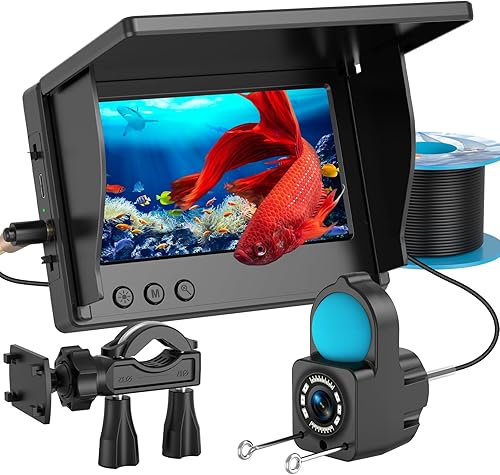
Underwater Fishing Camera TMACTIME 1080P HD: Best for kayaks and portability
- 4.3-inch LCD display
- 1080P HD lens with 6 IR lights
- IP68 waterproof to 15 m
- 5000mAh battery, up to 10 hours
A compact camera kit that fits a kayak or a small boat. The 4.3-inch screen and 15 m cable cover shallow lakes and ice, and it runs up to 10 hours.
Pros
- Light and easy to pack
- IP68 waterproof housing
- Plug-and-play setup
Cons
- Shorter cable than the FishPRO
- No video recording
The TMACTIME kit fits kayaks, canoes and small boats where a big monitor is in the way. The 4.3-inch LCD and the 15 m cable are sized for shallow lakes, ponds and ice fishing, and the whole kit weighs about a pound.
A stand and charging cable come in the box, so you can set the screen on the deck and fish.
Six IR lights handle low light, so the camera works at night or in murky water. The IP68 housing is rated to 15 m and takes a 100 kg load on the cable, which covers most lake and ice work.
TMACTIME rates the 5000mAh battery at up to 10 hours, and the kit is plug and play. The display runs in real time only, so there is no recording to review later.
The trade-off against the FishPRO is reach and screen size. The 15 m cable is the shortest camera cable in this group, and the 4.3-inch screen is harder to share than a 7-inch one.
On the other hand, a small kit is the one you actually carry.
Choose it if portability tops your list. Pick the FishPRO instead if you fish deeper water or want a larger view.
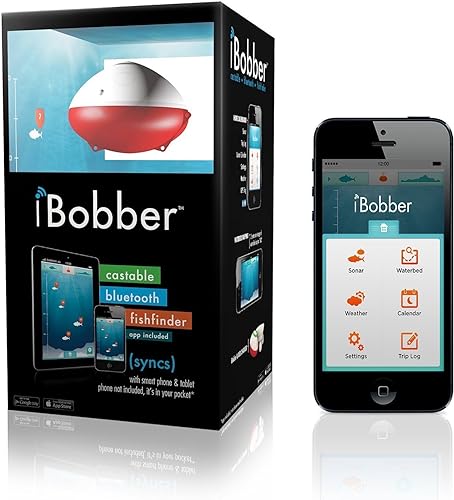
ReelSonar iBobber: Best for shore and dock fishing
- Castable wireless sonar
- Depth range to 135 ft
- 10+ hours of battery
- Fish and strike alarms
A pocket-sized sonar you cast on a line and read on your phone. It suits bank, dock and ice anglers who do not have a boat to mount a screen on.
Pros
- Castable from shore or a dock
- Depth-tagged fish icons
- Works over ice
Cons
- Depends on your phone screen
- Bluetooth range limits how far you wander
The iBobber is the pick for bank, dock and pier anglers who do not own a boat. It is a small castable sonar that pairs over Bluetooth with a free app on your phone, so the screen you read is the one already in your pocket.
ReelSonar calls it the smallest and lightest personal sonar on the market, and at two inches square it disappears in a tackle bag.
Its depth range reaches 135 ft, and the app colors fish icons by size and tags them by depth. A fish alarm and strike alert help when you are watching a rod rather than the screen.
The LED beacon keeps the unit visible in low light.
ReelSonar rates the battery at more than 10 hours. The app maps waterbeds, logs water temperature and depth, and keeps a trip log with spots and species.
An anti-glare setting helps when the sun is on your phone.
The limits are real. You depend on your phone, the Bluetooth link reaches about 100 ft, and a castable unit does not scan at boat speed.
Get it if you fish from shore or ice and want a cheap way to see depth and fish. Go with a mounted unit if you have a boat and want continuous scanning.
Humminbird Helix 5 CHIRP GPS G3: Best for GPS and lake maps
- Dual Spectrum CHIRP sonar
- Built-in Humminbird Basemap with 10,000+ lakes
- AutoChart Live mapping
- Keypad controls
A proper chartplotter with sonar, GPS and lake maps in one unit. It is the pick for boaters who want to mark spots and map contours, not just see depth.
Pros
- Built-in GPS and 10,000+ lake maps
- AutoChart Live contour mapping
- Wide and narrow CHIRP modes
Cons
- Costs more than a basic sonar
- Needs a 12 V boat power supply
The Helix 5 is the pick when you want GPS and lake maps in the same unit as your sonar. Humminbird's basemap covers more than 10,000 lakes and the continental U.S. coastlines, and AutoChart Live builds contour maps as you boat.
It records up to eight hours of bottom hardness and vegetation, and you can add premium LakeMaster, CoastMaster or Navionics charts when you want more detail.
Dual Spectrum CHIRP gives you two views. Wide Mode covers more water for finding fish, and Narrow Mode shows detail for structure and target separation.
The Low-Q transducer sharpens 2D target separation, so separate fish show as separate marks rather than one blur.
The 5-inch color TFT display and keypad controls are built for a wet, moving boat. Softkeys reach the settings you use most, and the buttons work with wet hands.
A transom-mount transducer, power cable and gimbal bracket come in the box, and the unit runs on a 12 V supply. At about two pounds it is easy to bracket on a console.
The trade-off is price and setup. It costs more than the simple sonar units here, needs boat power, and shows sonar arches rather than live video.
Read more in our picks for a fish finder with gps.
Pick it if mapping and spot marking matter. Pick a camera or a castable sonar if you mainly want to see fish.
Anminto Underwater Fishing Camera 5 Inch: Best for long camera sessions
- 5-inch IPS screen at 1000TVL
- 12 IR lights with one-click night mode
- IP68 waterproof
- 65 ft cable, 8000mAh battery
A camera kit built for all-day trips. The 8000mAh battery runs 10 to 14 hours, and the 178-degree view covers a wide patch of water under the ice or boat.
Pros
- 10 to 14 hours of battery
- Wide 178-degree view
- One-click night mode
Cons
- Shortest camera cable here
- Lower resolution than the FishPRO
The Anminto camera suits long days on the ice or a slow troll where you leave the camera down. Its 8000mAh battery runs 10 to 14 hours, so it covers a full trip without a recharge.
The 5-inch IPS screen has a 178-degree view, and 12 IR lights switch on with one click for dark or stained water. It is rated IP68 to 9000Pa, so deep or harsh water is not a problem.
The 65 ft cable is the shortest here, but the digital transmission keeps the picture steady along its length. Anminto lists a 100 kg pull strength on the cable, so it takes a snag without snapping.
The trade-off against the FishPRO is picture quality and reach. The FishPRO offers 1080P on 82 ft of cable and two lighting modes, while this one tops out at 1000TVL and 65 ft.
Its wide 178-degree view does show more water at once than the FishPRO's lens.
Get it if battery life is your main worry. Pick the FishPRO for the sharper image and longer cable.
Yoocylii Handheld Fish Finder: Best for simple handheld depth checks
- Handheld LCD display
- 200 kHz sonar, 45-degree beam
- Depth to 328 ft
- Runs on 4 AAA batteries
A cheap, pocketable sonar for depth and fish marks. Toss the transducer in the water and read the screen, which makes it a handy backup or first unit.
Pros
- Reads to 328 ft
- Neck strap for kayak use
- Works in fresh and salt water
Cons
- Runs on AAA batteries for 4 to 5 hours
- No GPS or mapping
The Yoocylii handheld is the simple, cheap way to read depth. Toss the transducer in the water, turn on the display and it shows water depth, fish marks and bottom type, including weeds, sand and rock.
A removable float keeps the transducer at the right depth when you cast it from the bank.
Its 200 kHz sonar reads from 3 ft to 328 ft on a 45-degree beam. It works in fresh and salt water, and the neck strap keeps it handy on a kayak.
The kit also includes a side-scan adapter and a stainless bolt for mounting on a boat or float tube.
Power comes from 4 AAA batteries, which last 4 to 5 hours of continuous use. Settings include five sensitivity levels, a battery-save mode, a backlight and a fish alarm, and the unit remembers them when you turn it off.
It works in temperatures from 14 to 113 degrees Fahrenheit.
The trade-off is features. It has no GPS, no mapping and no color sonar, and the battery life is the shortest here.
For a cheap first unit or a backup, though, it is hard to beat. It also reads deeper than any sonar on this list.
Pick it for quick depth checks from a kayak or dock. Pick a sonar with a bigger screen if you fish all day.
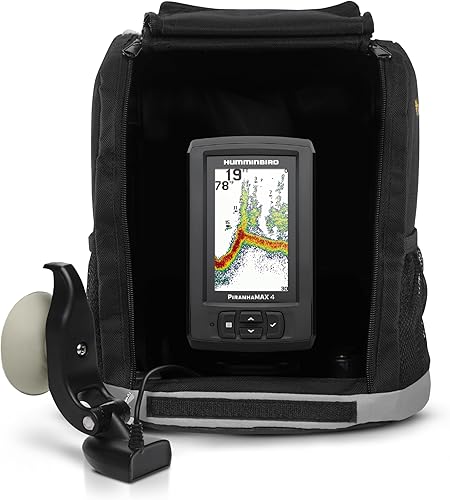
Humminbird PiranhaMAX 4 Portable: Best for grab-and-go boat trips
- Dual Beam sonar
- 4.3-inch color LCD
- Soft-sided carrying case
- 7 Ah battery and charger included
A self-contained kit in a carry case, with its own battery and charger. It suits anglers who move between boats or rent one and do not want wiring.
Pros
- Everything included in one case
- Dual Beam detail or coverage
- Tilt and swivel mount
Cons
- No GPS or maps
- Smaller screen than the Helix 5
The PiranhaMAX 4 Portable is a complete kit in a soft carry case. It includes the fish finder, a portable transducer, a 7 Ah battery and a wall charger, so you can move it between boats or rent one without wiring anything.
The case holds the transducer and battery together.
Dual Beam sonar lets you choose a wide beam for coverage or a narrow one for detail. The 4.3-inch color LCD has a tilt and swivel mount so you can angle it out of the sun.
Fish ID+, fish alarms, depth alarms and zoom are all on the menu, and Humminbird says the interface is simpler than earlier models.
The portable transducer uses a suction cup, so it sticks to a hull without drilling. The trade-off is that it has no GPS or maps, and its 4.3-inch screen is smaller than the Helix 5's.
At 2.5 pounds it is light enough to carry aboard in one hand.
Get it if you want one grab-and-go box for occasional trips. Go with the Helix 5 if you boat the same water often and want to mark spots.
Lowrance HOOK Reveal 5 SplitShot: Best for down-scanning structure
- FishReveal combines CHIRP and DownScan
- 5-inch SolarMAX display
- SplitShot transducer
- C-MAP inland maps and Genesis Live
A sonar unit with DownScan imaging and autotuning settings. It is the pick for anglers who want to read structure and drop-offs in more detail than basic sonar.
Pros
- DownScan structure images
- Autotuning sonar settings
- Preloaded maps of about 4,000 lakes
Cons
- Lower score for a beginner-friendly setup
- Needs 12 V DC power
The HOOK Reveal 5 SplitShot is the pick for anglers who read structure. FishReveal combines CHIRP sonar and DownScan imaging on one screen, so fish show up against rocks, brush and drop-offs.
Instead of switching between two views, you get the target separation of CHIRP and the detail of DownScan in one picture.
The SplitShot transducer gives wide-angle high CHIRP for finding fish and DownScan for structure detail. Autotuning sonar adjusts settings as conditions change, so you spend less time fiddling.
Lowrance says the transducer doubles the sonar coverage of other fishfinders in its class.
C-MAP US inland maps cover about 4,000 lakes, and Genesis Live builds custom contour maps in real time. The 5-inch SolarMAX display stays readable in direct sun.
The keypad has one-touch access to the main features, and the unit mounts on a front dash or a gimbal bracket. It needs a 12 V DC supply and draws on the boat battery.
The trade-off is that it sits at the bottom of this list for a first-time buyer. Its strengths show up most on familiar water where structure matters.
Read the river fishing picks if you fish current.
Choose it if DownScan detail is your priority. Choose a camera if you would rather see fish than structure.
Deeper Start: Best for bank and kayak casting
- Castable Wi-Fi sonar
- Casts to 165 ft and reads to 165 ft
- 40-degree beam
- Free Fish Deeper app
A castable sonar that pairs with a free app. It suits shore anglers and kayakers who want depth, bottom contour and fish marks without a mounted screen.
Pros
- No external battery or wires
- Saves scans with time and location
- Night fishing mode
Cons
- About 6 hours of battery
- Reads through your phone only
The Deeper Start is a castable sonar for shore and kayak anglers who want an app-based view. It casts out to 165 ft and reads to the same depth on a 40-degree beam.
It weighs about 2.5 ounces and needs no external battery or wires, so you tie it on and cast.
It makes its own Wi-Fi, so it does not use your mobile data, and it saves every scan with time and location for easy revisits. The Fish Deeper app shows fish location and size, depth, bottom contour and vegetation.
It works with iOS and Android, and the app is free.
The battery charges in about 2.5 hours and runs about 6 hours. A night fishing mode helps after dark.
The trade-off against the iBobber is depth and battery: the iBobber reads to 135 ft with more than 10 hours, while the Deeper Start reads to 165 ft but runs about 6 hours. Both need your phone.
The Deeper's 40-degree beam is narrower than the iBobber's, so it reads a tighter cone and needs more casts to cover the same water.
Pick it if you want a longer cast from the bank. Pick the iBobber if battery life matters more than casting distance.
How the fish finders under 500 dollars compare
| Product | Best for | Display size | Max depth | Power | Our score |
|---|---|---|---|---|---|
| [FishPRO® 2026 Upgrade] NO.1 HD 1080P Underwater | overall | 7 in | 82 ft | 10,000mAh battery | 9.6 |
| Underwater Fishing Camera TMACTIME 1080P HD | kayaks and portability | 4.3 in | 15 m | 5000mAh battery | 9.4 |
| ReelSonar iBobber | shore and dock fishing | Rechargeable battery | 9.1 | ||
| Humminbird Helix 5 CHIRP GPS G3 | GPS and lake maps | 5 in | 8.8 | ||
| Anminto Underwater Fishing Camera 5 Inch | long camera sessions | 5 in | 65 ft cable | 8000mAh battery | 8.7 |
| Yoocylii Handheld Fish Finder | simple handheld depth checks | 4 AAA batteries | 8.2 | ||
| Humminbird PiranhaMAX 4 Portable | grab-and-go boat trips | 4.3 in | 7 Ah battery | 7.7 | |
| Lowrance HOOK Reveal 5 SplitShot | down-scanning structure | 5 in | 7.3 | ||
| Deeper Start | bank and kayak casting | Rechargeable, about 6 hours | 7.2 |
How these were compared
We compared the specs each unit lists: display size and type, sonar or camera type, depth range, battery life, mounting, mapping and what comes in the box. Then we matched each one to the angler it serves best.
Our score weighs specs, features and buyer feedback against what you're shopping for. The FishPRO camera tops the list because it delivers the clearest view of what is actually under the boat for most people.
We did not run these units on the water. This is a research comparison, and the facts come from each maker's published specifications.
Where a maker lists two figures, such as a 1000TVL screen and a 1080P output, we note both rather than pick one.
Video cameras versus sonar units in one list
This list mixes two kinds of gear. The FishPRO, TMACTIME and Anminto are cameras that hang a lens on a cable and show live video.
The Helix 5, HOOK Reveal, PiranhaMAX 4 and Yoocylii are sonar units that send a sound pulse down and draw the return on a screen. The iBobber and Deeper Start are castable sonar read through a phone.
That matters because the numbers do not compare directly. A camera's 82 ft cable is a physical limit, while a sonar unit's 328 ft depth range is a reading limit.
Reading the specifications without getting fooled
Three numbers deserve a close look. First, resolution: a 1000TVL camera and a 1080P camera are not the same, and a "1080P" label on a 1000TVL screen describes the output more than the panel.
Second, battery life: makers quote best-case hours, and cold weather on the ice always cuts that figure. Third, depth: a sonar depth range assumes good conditions, and deep readings in rough water or over soft bottoms are less reliable.
What should you check before buying a fish finder under 500 dollars?
Start with how you fish. A boat owner who wants to return to spots needs GPS and maps, while a shore angler needs a castable unit and a kayaker needs something light.
A camera answers a different question than sonar, so decide which view you want first. Then check the power source, the cable or depth limit, and what comes in the box.
Do you fish from a boat, a kayak or the shore?
Boat anglers get the most from a mounted unit like the Helix 5 or the HOOK Reveal, which scan while you move. Kayakers do well with the TMACTIME kit or the Yoocylii handheld.
Shore and dock anglers should look at the iBobber or the Deeper Start. Ice anglers can use any of the cameras, because a hole gives you a still, clear window to lower a lens through.
Do you want video or sonar?
A camera like the FishPRO shows fish, bait and structure in color and helps you see how fish react to your lure. Sonar covers more water faster and works at speed or in deep water.
A camera is the better first buy if you fish slow and shallow. A sonar unit is the better first buy if you cover a lot of water or fish deep.
How much screen do you need?
A 7-inch IPS screen like the FishPRO's is easy to share and read in sun. A 4.3-inch screen like the PiranhaMAX or TMACTIME is lighter and easier to pack.
If you fish with a partner or in bright light, go bigger. An IPS panel also holds its colors from side angles, while a basic LCD or TN panel washes out when you look from above.
How long do you fish in one trip?
Camera batteries here run from about 6 hours to 20 hours. The FishPRO and the Anminto cover a long day, while the Deeper Start runs about 6 hours.
Sonar units like the Helix 5 run on boat power, so trip length is less of a limit. On the ice, cold cuts every battery figure, so plan a top-up or a spare.
What power and wiring does your boat have?
The Helix 5 and HOOK Reveal need a 12 V DC supply. The PiranhaMAX 4 Portable includes its own 7 Ah battery, and the FishPRO, TMACTIME and Anminto cameras have built-in batteries.
The FishPRO's USB-C port lets you run it from a power bank, which is a handy backup when the trip runs long.
Do you need to keep a record of your spots?
GPS units save waypoints and build maps. The iBobber and Deeper Start save scans in their apps.
Cameras here do not record video, and the FishPRO's listing says plainly that it has no HDMI port and no recording, so check for a recording feature before you buy if you want to review footage later. For a low-cost first step, see the fish finder under 200 dollars picks.
What comes in the box, and what do you still need to buy?
The FishPRO kit includes the monitor with its built-in battery, the camera and spool, a USB-C cable, a charger, the adjustable fin, a portable box and two weights. The PiranhaMAX 4 Portable includes its own battery and wall charger.
The Helix 5 and HOOK Reveal come with transducers, cables and mounting brackets but need a boat power supply. The Yoocylii needs 4 AAA batteries, which are not included.
Which fish finder under 500 dollars should you buy?
The best fish finder under 500 dollars for most anglers is the FishPRO 2026 Upgrade HD 1080P Underwater Camera, because live video answers what sonar only hints at. Choose the Humminbird Helix 5 CHIRP GPS G3 for GPS and lake maps, or the ReelSonar iBobber for shore and ice fishing.
If you want to see fish in color and have the budget, start with the FishPRO. If you boat the same water and want to mark spots, the Helix 5 is the better fit.
For a cheap first sonar or a backup, the Yoocylii handheld does the basic job.
If this is your first unit, read our guide to fish finders for beginners before you order. It walks through setup and what the screen is telling you.
Our top 3 picks at a glance
-
1
-
2
Best for kayaks and portability
Underwater Fishing Camera TMACTIME 1080P HD
9.4/10 our score
See it on Amazon -
3
Frequently asked questions
Do I need a separate battery for a fish finder?
It depends on the model. The Humminbird PiranhaMAX 4 Portable includes a 7 Ah battery and charger, while the FishPRO camera has a built-in 10,000mAh battery.
The Helix 5 and Lowrance HOOK Reveal need a 12 V boat supply.
Can I use a fish finder from the shore without a boat?
Yes. Castable sonar like the ReelSonar iBobber and the Deeper Start works from a bank or dock.
You cast the unit on a line and read depth and fish marks in an app on your phone.
Is an underwater camera better than sonar for finding fish?
A camera shows real fish, bait and structure in color, which helps identify species and see how fish react to your lure. Sonar covers more water faster and works better at speed or in deep or murky water.
Many anglers use both.
Do I need GPS on a fish finder?
GPS helps you return to productive spots and map lake contours. If you fish unfamiliar water or want to build your own map, a unit like the Humminbird Helix 5 is worth the extra.
For quick depth checks, plain sonar costs less.