9 Best Fish Finders Under $300 (November 2026)
The best fish finders under 300 dollars include the FishPRO 2026 Upgrade HD Underwater Camera for seeing what is down there, the TMACTIME 1080P HD Underwater Camera for a small boat or kayak screen, and the ReelSonar iBobber for shore and dock casting.
On this page (4 sections)
The best fish finder under 300 dollars is the FishPRO 2026 Upgrade HD camera, because it gives you a live 1080P color picture on a 7-inch IPS screen and runs up to 20 hours on a built-in battery. Pick a castable sonar like the ReelSonar iBobber for bank fishing, or the Lowrance Eagle 4x if you want a unit bolted to your console.
This price band covers three different tools, and they do different jobs. An underwater camera shows you a picture of the water.
A castable sonar sends a signal out and reads depth and fish marks on a phone or small screen. A boat-mounted sonar stays fixed to the hull and shows depth and bottom shape on its own display.
The right pick depends on where you fish and how much gear you want to carry. Ice anglers and clear-water fishers get more from a camera.
Bank and dock anglers do better with a castable unit. Console boats want a fixed screen with a transducer.
Our picks at a glance
-
1
 Best for seeing what is down there
FishPRO 2026 Upgrade HD Underwater Camera
9.6/10 our score
See it on Amazon -
2
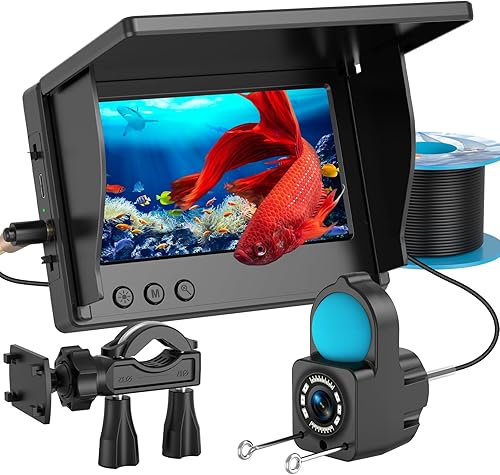 Best for a small boat or kayak screen
TMACTIME 1080P HD Underwater Camera
9.4/10 our score
See it on Amazon -
3
- 4
 Check it
Anminto 5 Inch Underwater Camera
Best for long days in dark water - 5
 Check it
LUCKY Portable Handheld Fish Finder
Best for checking depth from a kayak - 6
 Best for mapping a lake you fish oftenCheck it
- 7
 Best for a permanent console mountCheck it
- 8
 Best for quick trips from the bankCheck it
- 9
 Check it
LUCKY Kayak Wireless Fish Finder
Best for casting from a kayak without drilling
The best fish finders under 300 dollars for different anglers
The FishPRO camera is the best all-around choice because it works in ice holes, from a boat and from a dock, and the battery covers a full day. Every other pick here solves a narrower problem, so choose by how and where you fish.
FishPRO 2026 Upgrade HD Underwater Camera: Best for seeing what is down there
- 7-inch full-color IPS monitor
- 1080P camera with 82 ft cable
- 10,000mAh battery, up to 20 hours
- IR and white LED light modes
A live color picture of your bait, the bottom and the fish around it. The long battery life and both light modes make it useful in daylight and in dark water.
Pros
- Real-time 1080P picture
- Up to 20 hours per charge
- IR and white LED lighting
Cons
- No video recording or HDMI port
- Camera on a cable, not a sonar scan
The FishPRO suits an angler who wants to see the water, not just read a mark on a screen. Its 1080P camera sends a live color picture to a 7-inch IPS monitor, and the screen stays readable from steep angles and in sunlight.
The 10,000mAh battery runs up to 20 hours, and the USB-C port lets you fish while charging from a power bank. That matters on long ice trips where cold drains batteries.
Two light modes set it apart. Tap the LED/IR button for a black-and-white infrared view in dark water or a full-color white LED view when you want color.
The 2026 monitor also shows which light mode is active, so you always know what you are looking at. The 82 ft cable is rated to 88 lb and uses a magnetic spool that lets you separate the monitor from the cord.
A set of adjustable fins at 45, 90 and 180 degrees lets you point the camera at the bottom or level with the water.
One thing to know: it does not record video and has no HDMI port, so you watch in real time only. Skip it if you want to save clips.
Buy it if seeing your bait and the fish around it matters more than keeping footage.
TMACTIME 1080P HD Underwater Camera: Best for a small boat or kayak screen
- 4.3-inch LCD display
- 1080P camera with 15 m cable
- Six IR lights for low light
- 5,000mAh battery, up to 10 hours
The same live-view idea as the top pick in a smaller, lighter package. The 4.3-inch screen and 15 m cable suit cramped kayak and canoe cockpits.
Pros
- Compact 4.3-inch display
- IP68 waterproof camera and cable
- Plug and play, no setup
Cons
- Real-time viewing only, no recording
- Shorter cable than the top pick
TMACTIME covers the same ground as the top pick in a smaller kit. The 4.3-inch LCD screen and the 15 m cable fit a kayak or canoe cockpit where a 7-inch monitor would crowd your lap.
Its 1080P camera pairs with six IR lights for low-light viewing. The camera and cable are rated IP68 waterproof and handle a 100 kg load, which is more than most anglers will ever pull against.
A CMOS sensor and autofocus keep the picture sharp when the water is moving.
The 5,000mAh battery runs about 10 hours. That's enough for a day trip, though half what the FishPRO offers on a charge.
A small stand is included, so you can set the monitor down instead of holding it.
Setup is plug and play: connect the monitor to the camera and lower it. There's no app and no pairing step, so it's a strong first camera for someone who wants to keep things simple.
This model also does real-time viewing only. Buy it for a small boat or a kayak where a compact screen helps, and choose the FishPRO when you want the longer battery and the bigger monitor.
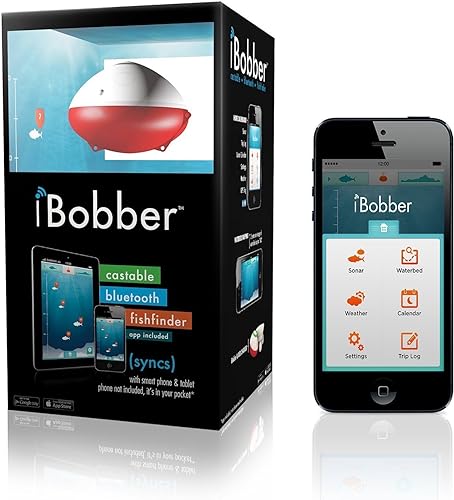
ReelSonar iBobber: Best for shore and dock casting
- Castable wireless sonar
- Depth range up to 135 ft
- 10+ hours per charge
- Fish and strike alarms
Tie it to your line, cast it out and read depth, bottom shape and fish size on your phone. A good fit for bank and dock anglers who cannot mount a screen.
Pros
- Casts from shore or dock
- Sonar depth up to 135 ft
- Fish and strike alarms
Cons
- View is on your phone, not a fixed screen
- Short wireless range from the phone
The iBobber is the easiest way to read water you can't reach from shore. Tie it to your line, cast it like a bobber, and its sonar sends depth, bottom shape and fish size to the free app on your phone.
Its depth range reaches 135 ft. Fish icons are color coded by size and tagged with depth, so you can see what's under a dock or pier without owning a boat.
Turn on the fish alarm to get a signal when fish gather under you, or the strike alert when they are biting.
The rechargeable battery runs 10+ hours. The app also logs water temperature and depth and lets you save spots in a trip log, which helps you return to productive water.
An LED beacon and a high-contrast body make the unit easier to spot on the water in bright light.
The trade-off is the screen: everything shows on your phone, and the wireless link works up to about 100 ft. That's fine for casting from a bank.
It's less handy when you're already looking at a mounted display.
Buy it for shore, dock and pier fishing. Choose a camera or a fixed sonar unit when you fish mostly from a boat.
Anminto 5 Inch Underwater Camera: Best for long days in dark water
- 5-inch IPS screen, 178° viewing angle
- 12 IR lights with one-click night mode
- 8,000mAh battery, 10 to 14 hours
- 65 ft cable rated to 100 kg pull
A wide-angle camera with strong night lighting. The 178° lens shows more of the scene at once, and the battery covers a full day of checking holes.
Pros
- Wide 178° viewing angle
- Long 10 to 14 hour battery
- One-click night mode
Cons
- Shorter cable than the FishPRO
- No recording of what you see
Anminto suits an angler who spends long days in dark or murky water. Its 12 infrared lights and one-click night mode make the view usable when there's little natural light.
The 178° viewing angle shows more of the scene at once than a narrower lens. That helps you spot fish at the edge of the frame and judge how they react to your bait.
Its 8,000mAh battery runs 10 to 14 hours. The 65 ft cable is rated to a 100 kg pull, and the maker says the digital transmission stays lag free even on the full cable.
The camera is IP68 rated and handles up to 9000Pa of pressure, so it copes with deep water and harsh conditions.
The screen is a 5-inch IPS panel, smaller than the FishPRO's 7-inch monitor but still comfortable to read. Like the other cameras here, it shows real time only and does not record.
Buy it for night fishing and stained water where lighting matters most. Pick the FishPRO instead if you want a longer cable and a bigger screen for the same kind of work.
LUCKY Portable Handheld Fish Finder: Best for checking depth from a kayak
- 2.4-inch color LCD
- 26 ft wired transducer
- 328 ft depth detection
- 45° beam at 200 kHz
A simple sonar unit that reads depth, bottom contour and fish size on its own screen. The bracket lets you fix the transducer to a kayak or small boat.
Pros
- Reads depth to 328 ft
- Own screen, no phone needed
- Bracket for kayak mounting
Cons
- About 5 hours per charge
- Small 2.4-inch display
The LUCKY handheld is a traditional sonar unit in a small package. It reads depth, bottom contour, water temperature and fish size on its own 2.4-inch color screen, so there's no phone and no app.
Its 200 kHz transducer uses a 45° beam and reaches 328 ft. The wired transducer gives you a steady signal over 26 ft of cable, and the included bracket lets you fix it to a kayak or small boat.
A simulation mode lets you try every menu option before you get on the water.
The rechargeable battery runs about 5 hours. Brightness adjusts for sun or shade, and the menu lets you set sensitivity, depth range, zoom and alarms.
You can also choose among three contour display styles and switch units between feet and meters.
The small screen is the main trade-off: 2.4 inches is fine for depth and fish marks but not for detail. The short battery life also means a mid-day charge on long trips.
Buy it for a kayak or small boat where you want a standalone screen and don't mind recharging. Go with a castable unit if you fish from shore more than from a boat.
Deeper PRO+ 2: Best for mapping a lake you fish often
- Castable Wi-Fi sonar
- Depth to 330 ft
- Built-in GPS for bathymetric maps
- Wide, mid and narrow beams
The only pick here with built-in GPS, so it builds depth maps you can save and revisit. The three beam widths let you sweep open water or pick apart a tight spot.
Pros
- GPS map building
- Depth to 330 ft
- Three beam widths
Cons
- No screen of its own
- Higher price tier than the castable basics
The Deeper PRO+ 2 is the only pick here that builds maps. Its built-in GPS saves bathymetric maps to the Fish Deeper app, so you can return to the same hump or drop-off on your next trip.
It casts from shore or boat and reads to 330 ft. Three beam widths let you sweep open water with the wide beam or pick apart a tight spot with the narrow one.
Target separation is 0.4 in on the narrow beam and 1 in on the wide and mid beams, so it can tell a fish from a weed or track even a small vertical jig.
It runs its own Wi-Fi signal, so it doesn't use your mobile data. Everything shows on your phone, and the app keeps every scan with a time and location stamp.
A neoprene pouch and two attachment bolts come in the box.
There's no screen of its own, and it sits in a higher price tier than the basic castable units. Buy it if you fish the same lake often and want to learn its shape.
For a first castable unit, the iBobber costs less and covers the basics.
Lowrance Eagle 4x: Best for a permanent console mount
- 4-inch IPS portrait screen
- 200 kHz Bullet Skimmer transducer
- Auto-Tuning Sonar
- Depth to 500 ft
A traditional dash unit that bolts to a small boat and stays there. The auto-tuning sonar takes the guesswork out of settings, and the screen stays readable in sun.
Pros
- Reads to 500 ft
- Readable IPS screen in sunlight
- Auto-Tuning Sonar
Cons
- Needs a fixed mount and wiring
- No GPS and no fish alarm
The Lowrance Eagle 4x is the pick for a boat where the unit stays mounted. Its 4-inch IPS screen is readable in direct sun and through polarized sunglasses, and the portrait shape fits a small console.
Auto-Tuning Sonar sets the sonar controls for you, so you spend less time fiddling and more time fishing. The included 200 kHz Bullet Skimmer transducer gives a 44° beam for kayaks and small boats, and depth reads to 500 ft.
A twist-lock collar lets you pull the display off without tools.
Fish show as icons with depth, and zoom lets you look closer. Note that it does not have an audible fish alarm, so watch the screen rather than listen for a beep.
The trade-offs are real: no GPS, no fish alarm, and you need a fixed mount plus wiring. Buy it for a dedicated boat.
If you fish from shore or a kayak and want to move the unit between spots, a castable model or a camera fits better.
Deeper Start: Best for quick trips from the bank
- Castable Wi-Fi sonar
- Depth to 165 ft
- 40° beam
- 6 hours per charge
The simplest way to see depth, bottom contour and fish from shore. It pairs with the free app in minutes and has no wires to tangle.
Pros
- Easy for first-time sonar users
- Casts from shore or kayak
- Saves scans with time and location
Cons
- 165 ft depth limit
- 6 hours per charge
The Deeper Start is the simplest castable unit here. Pair it with the free app, cast it out and you'll see fish location and size, depth, bottom contour and vegetation in minutes.
Its 40° beam reads to 165 ft, and the casting range is also 165 ft. A night fishing mode keeps the view usable after dark.
The rechargeable battery reaches full charge in 2.5 hours and runs about 6 hours.
Scans save with a time and location stamp, so you can return to a spot that held fish. The unit makes its own Wi-Fi, so it won't eat your mobile data.
That's useful for someone learning a new pond or stretch of bank.
The 165 ft depth limit is the shallowest of the castable units here, and 6 hours per charge means a charge on a long day. Buy it as a first sonar unit for bank and kayak trips.
Go with the iBobber for more depth, or the PRO+ 2 for mapping.
LUCKY Kayak Wireless Fish Finder: Best for casting from a kayak without drilling
- Wireless sonar with 853 ft range
- 3.5-inch horizontal LCD
- 90° beam
- 147 ft depth range
A castable sensor with its own screen, so you do not need a phone or a mount. The wide beam covers a lot of water, and the long wireless range suits a kayak.
Pros
- Own screen, no phone needed
- Very long wireless range
- 90° wide beam
Cons
- Shallowest depth limit here
- Screen scrolls right to left, which takes getting used to
The LUCKY wireless unit gives you a castable sensor and its own 3.5-inch screen, so you don't need a phone. The wireless range reaches up to 853 ft, the longest in this group.
The 90° beam is wide, covering a lot of water on each cast. Depth reads from 3 ft to 147 ft, and the screen shows fish icons with depth numbers next to them.
The sensor floats and comes with a safety tether, so you tie it to your line and cast it like a bobber.
The horizontal display scrolls from right to left, so you see a running history of what just passed under the sensor. That's handy for tracking a fish's movement or locating structure you've drifted over.
The whole kit weighs less than a 1 liter water bottle.
The trade-offs stack up against the other picks. It has the shallowest depth limit here, and the scrolling display takes some getting used to.
Buy it for kayak fishing without drilling holes or running wires. Choose the iBobber or Deeper Start when depth range matters more.
How these fish finders under 300 dollars compare
We compared these models on the specs that change how you fish: depth limit, screen type and size, battery life, light modes and whether the unit needs a mount or a phone. Our score weighs specs, features and buyer feedback against what you're shopping for.
Cameras and sonar units aren't directly equal, so the score favors how well each model does its own job. The FishPRO camera scores highest because it covers ice, boat and dock fishing with a long battery and a readable screen.
The castable sonar units score well for portability. The boat-mounted Eagle 4x scores lower here because it needs a fixed install, which narrows who it suits.
Two units read the same water but present it very differently: a camera shows color and fish behavior, while a sonar unit shows depth and marks. That difference matters more than any single spec when you pick a side.
| Product | Best for | Type | Max depth | Display | Our score |
|---|---|---|---|---|---|
| FishPRO 2026 Upgrade HD Underwater Camera | seeing what is down there | Underwater camera | 82 ft | 7-inch IPS | 9.6 |
| TMACTIME 1080P HD Underwater Camera | a small boat or kayak screen | Underwater camera | 15 m | 4.3-inch LCD | 9.4 |
| ReelSonar iBobber | shore and dock casting | Castable sonar | 135 ft | Phone or tablet app | 9.1 |
| Anminto 5 Inch Underwater Camera | long days in dark water | Underwater camera | 65 ft | 5-inch IPS | 8.7 |
| LUCKY Portable Handheld Fish Finder | checking depth from a kayak | Sonar with wired transducer | 328 ft | 2.4-inch color LCD | 8.6 |
| Deeper PRO+ 2 | mapping a lake you fish often | Castable sonar with GPS | 330 ft | Fish Deeper app | 8.5 |
| Lowrance Eagle 4x | a permanent console mount | Boat-mounted sonar | 500 ft | 4-inch IPS | 7.6 |
| Deeper Start | quick trips from the bank | Castable sonar | 165 ft | Fish Deeper app | 7.2 |
| LUCKY Kayak Wireless Fish Finder | casting from a kayak without drilling | Castable wireless sonar | 147 ft | 3.5-inch horizontal LCD | 6.8 |
What should you check before buying a fish finder under 300 dollars?
Start with where you fish and how you'll read the result. A camera needs clear water or its own lights.
A castable sonar needs a phone or a screen and a clear casting lane. A mounted unit needs a boat and wiring.
Camera or sonar?
Choose a camera when you want to see fish react to your bait, judge size and species, or fish through ice. The FishPRO, TMACTIME and Anminto all show a live picture.
A camera also lets you watch how a fish approaches a lure before it strikes, which a sonar mark alone cannot show.
Choose sonar when you need to cover water fast or read depth over a wide area. The iBobber, both Deeper units and the LUCKY models scan below the sensor and show depth and fish marks.
Sonar covers more water per cast, while a camera shows more detail in one spot.
How deep do you need to read?
Match the depth limit to your water. The LUCKY wireless tops out at 147 ft and the Deeper Start at 165 ft, which covers most ponds and small lakes.
The iBobber reaches 135 ft and the FishPRO camera 82 ft on its cable.
For big water, the LUCKY handheld reads to 328 ft, the Deeper PRO+ 2 to 330 ft and the Lowrance Eagle 4x to 500 ft. A camera's limit is set by its cable length as well as the water, so check both when you plan deep trips.
Do you fish from shore, a kayak or a boat?
Shore and dock anglers do best with a castable unit like the iBobber or Deeper Start. Kayak fishers can cast a sensor or mount a small transducer, as the LUCKY handheld allows.
Boat owners get the most from a fixed unit like the Eagle 4x.
If you fish from several platforms, a camera or a castable sonar moves between them with no install. That's why the top pick suits so many anglers.
Our guide to the best fish finders for beginners walks through first-time setups.
Screen, phone or no screen at all?
A dedicated screen means no phone battery drain and no pairing step. The FishPRO, TMACTIME, Anminto and LUCKY units all have one.
Phone-based units like the iBobber and both Deeper models keep the hardware small and the app does the display work. The phone app also tends to offer more logging and map tools than a fixed screen.
If you already run a phone on the water and don't want another screen, a castable unit saves space. If you'd rather leave the phone in your pocket, pick a unit with its own display.
Check that the monitor size suits your boat or ice shelter before you commit.
Do you want to save spots?
Only the Deeper PRO+ 2 here has GPS. It builds depth maps and saves scans with a time and location stamp.
If marking spots matters, read our guide to the best fish finders with GPS before you choose.
The other models show what's under the sensor but don't record position. For river work, where the bottom shifts with each rise and fall, a camera or a castable unit you can move quickly may serve you better.
See our picks for the best fish finders for river fishing.
How long does the battery need to last?
Work out your typical trip length. The FishPRO camera runs up to 20 hours and the Anminto 10 to 14 hours, so both cover a full day.
The TMACTIME and iBobber run about 10 hours.
The LUCKY handheld runs about 5 hours and the Deeper Start about 6, so plan a charge or a power bank on long days. Cold weather shortens battery life for every model here, so an ice angler should carry a power bank even on a camera rated for 20 hours.
The FishPRO's USB-C port lets you charge while it runs. If your budget is tighter, our list of the best fish finders under 200 dollars covers the entry-level options.
Which fish finder under 300 dollars should you buy?
The FishPRO 2026 Upgrade HD camera is the best fish finder under 300 dollars for most anglers, because it works from ice, boat and dock and runs all day on one charge. Buy the ReelSonar iBobber if you fish from shore and want to cast your sonar.
Pick the Lowrance Eagle 4x for a permanent console mount, or the Deeper PRO+ 2 if you want to map a lake you return to.
If you want a live picture of your bait and the fish around it, choose a camera. If you want depth and fish marks over a wide area, choose sonar.
Either way, match the depth limit to your water and the battery to your trip length before you buy.
Our top 3 picks at a glance
-
1
Best for seeing what is down there
FishPRO 2026 Upgrade HD Underwater Camera
9.6/10 our score
See it on Amazon -
2
Best for a small boat or kayak screen
TMACTIME 1080P HD Underwater Camera
9.4/10 our score
See it on Amazon -
3
Frequently asked questions
Is an underwater camera or a sonar unit better under 300 dollars?
An underwater camera shows you a live picture of fish and structure, which makes it easier to judge size and species. A sonar unit reads depth, bottom shape and fish marks over a wider area.
Pick the camera for ice holes and clear water, and sonar for covering water fast.
Do I need a boat to use a fish finder under 300 dollars?
No. Several castable models here work from shore, a dock or a kayak.
You tie the sensor to your line, cast it out and read the result on a phone app or a small screen that comes with the unit.
How deep can these fish finders read?
The models here range from 147 ft on the LUCKY wireless castable to 500 ft on the Lowrance Eagle 4x. Most fishing in lakes and rivers happens in less than half that depth, so depth limit matters more for big water than for ponds.
Can a fish finder under 300 dollars show GPS maps?
Only the Deeper PRO+ 2 in this group has built-in GPS. It saves depth maps to the Fish Deeper app so you can return to the same spots.
The other models read the water under the sensor but do not record position.
Will these fish finders work through ice?
Yes. Underwater cameras in this group are built for ice fishing, and several castable sonar units list ice use as well.
Set the camera or sensor in the hole and read the screen from the ice.